Light
Dark
Creative Industry
Culture & Tech
Future of Work
Human Craft Is Worth More Than Ever: What Survives the Blanding
Execution has been commoditized. Human craft has not. The market is learning, faster than anyone predicted, to see the difference between what a person made and what a machine extruded. This piece names what survives the Blanding and what to do about it.
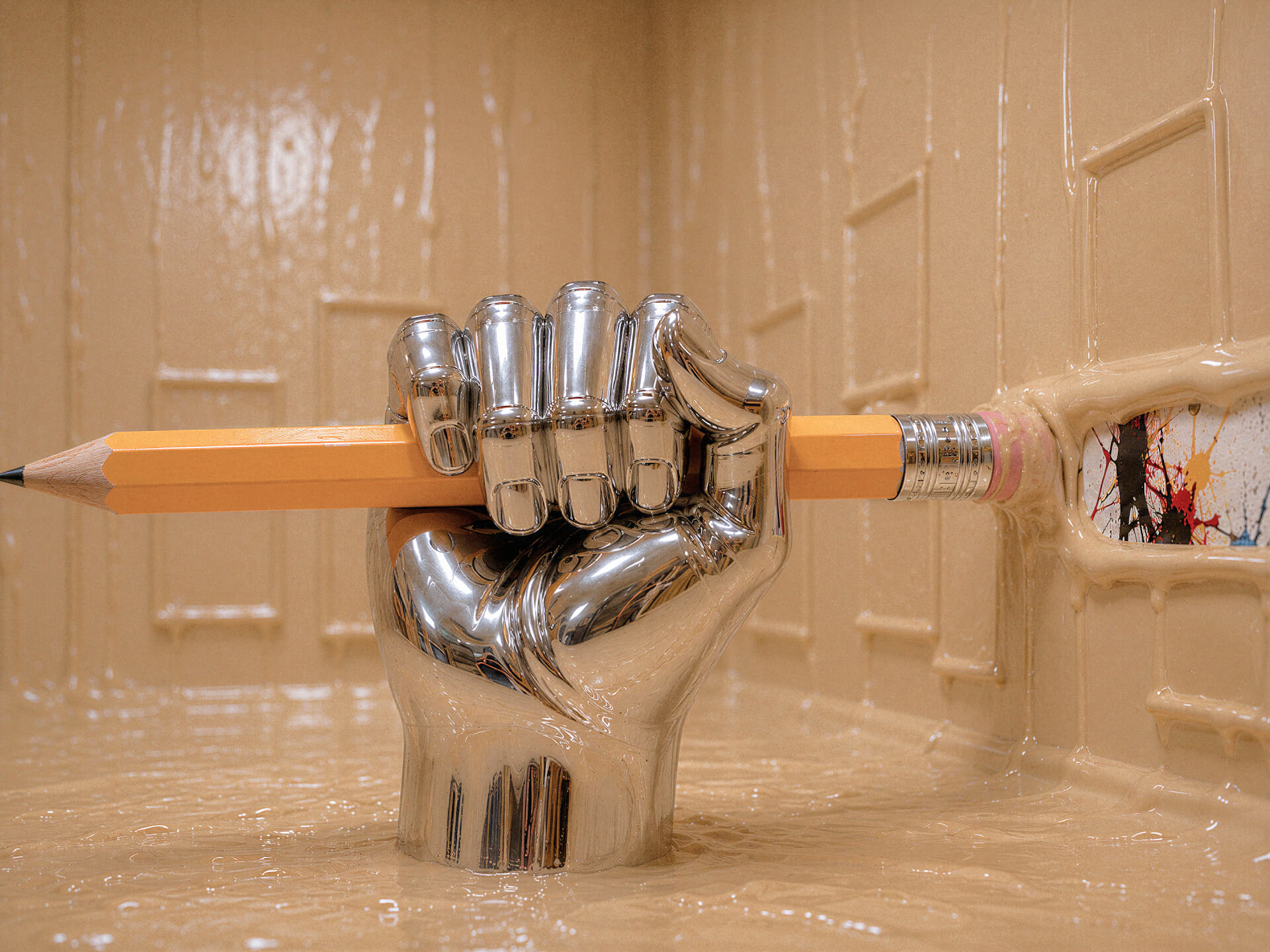
We Wrote Four Prosecutions. This One Is Not That.
For four pieces now we have been prosecuting.
In the first, we named the cost. The specific person at the specific desk at eleven at night, doing math about rent, trying to survive a wave that nobody asked them to stand in front of. In the second, we prosecuted the executives who ship inferior work and call it innovation, shielded by AI-themed borrowed language. In the third, we named the mechanism. The way AI has become a culturally protected phrase that launders decisions that would have been indefensible in any other costume. In the fourth, we prosecuted the commercial class that has organized itself around monetizing the exhaustion of the masses, at every price point the market will bear.
Four prosecutions. Each aimed at someone specific. Each written in teeth sunk into concrete.
This one is not that.
This one is for you. The person who has read some or all of the above. The one still trying to figure out what to actually do inside the moments we have been describing. The designer wondering if the craft they spent a decade developing is being erased. The writer wondering if the discipline of thinking carefully on a page still has a market. The developer wondering if the years of architectural judgement they built up are about to become worthless. The founder wondering whether the brand they are trying to build will even register in a feed full of cringe-first, AI slop. The middle-of-career professional doing the same quiet work they have been doing for years, wondering whether the world has stopped paying attention to what they actually do.
We are not going to tell you the moment is easy. It’s not. We are not going to tell you nothing has changed. It has. A lot. We are not going to tell you your discipline is safe in the form you have known it. No discipline is.
What we are going to do is name, precisely, with evidence, what is actually worth defending right now. Not as motivation. Not as reassurance. But as an argument. Because if the previous four pieces have done their work, you now know what is being corroded. This piece names what is not being corroded, and why. And it asks you to build your practice, from this week forward, around those things specifically.
The argument has three parts, in three sentences.
Craft is becoming scarce because execution has been commoditized. The market is learning to detect craft through the visible cracks between human and machine. The practitioners protect craft by staying close to the actual work.
We will take those three sentences in order. We will show you, in each case, the evidence that it is true. And we will end, quietly, with no pretense of authority we do not have, with a word about what this asks of you, specifically.
One: Craft Is Becoming Scarce
For the past thirty years, a particular kind of competitive advantage has been disappearing from every knowledge-economy discipline. The advantage was execution. The ability to produce the thing, at competent quality, reliably, at scale. If you could execute well, write the competent brief, design the competent layout, ship the competent code, produce the competent report, you had a job. Craft, in the older sense of the word, was optional. Execution was the floor. Execution was the product.
Execution is no longer the product.
The generalist AI tools of 2024–2026 have raised the floor of execution across every discipline, for everyone, at roughly zero marginal cost. The competent brief can be produced in fifteen minutes by someone who has never studied briefs. The competent layout can be generated in an afternoon by someone who has never thought about composition. The competent code can be prompted into existence by someone who does not understand the system it is being written for. Competence has been commoditized, almost completely, almost everywhere. The floor is now the ceiling for anyone who only ever had the floor.
What has not been commoditized, and cannot be, is the discernment underneath the execution. The judgement that decides which brief to write. The taste that decides which layout is right for this specific audience, on this specific device, in this specific cultural moment. The systemic understanding that decides which code architecture is going to survive contact with real users. The editorial intuition that decides which observation is worth publishing and which one is noise. These are not execution. These are the quiet, unteachable, hard-won capacities that sit underneath execution and direct it.
This set of capacities is what we are calling, throughout this piece, craft. It is not a nostalgic word. It is not about doing things by hand for the sake of doing them by hand. It is the specific, technical, practitioner-earned capacity for judgement. About quality. About fit. About when something is wrong. About when something is finished. About when to push harder. And when to stop. Every real discipline has its own version. Every real practitioner develops their own, over years, through work.
The economic observation of this moment is: the disciplines where execution has just been commoditized are about to discover that craft is the remaining scarce resource. The practitioners who invested in craft, over the last decade, are about to get the return on that investment. The practitioners who invested only in process, only in tooling, only in repeatable workflows, are about to find that their investments are worth considerably less. This is not a prediction. It is already visible in the pricing structure of every discipline where AI has properly arrived, if you look closely enough at who is being paid for what.
This is, incidentally, the economic underpinning of our earlier argument about taste. That taste is not preference. Taste is judgement you have to earn through repeated contact with the thing itself. The earlier piece made the philosophical case. This piece is naming the market mechanism. The two are the same claim, viewed from different angles.
If you are someone who has been quietly honing judgement for a decade while the rest of the discourse has been chasing tooling, congratulations. The years you thought you were falling behind on process were years you were, in fact, building the asset whose price is about to go up. You have not been slow. You have been compounding.
Two: The Market Is Learning to See the Seam
Here is where the argument becomes testable, because this is the part that has already started showing up in public data.
In September 2025, Spotify announced that it had removed over seventy-five million AI-generated tracks from its platform over the preceding twelve months. That is not a small number. That is roughly half its archive. Spotify did not remove these tracks because someone from the outside made them. Spotify removed them because the platform’s own user-behavior data had surfaced them as what Spotify’s own statement called “slop.” Content that was degrading the listener experience, diverting royalties from authentic artists, and losing the platform’s audience. The market, not the regulator, produced the cleanup. Listeners were telling Spotify, through their skip rates and their complaints and their dwindling engagement, that they could hear the difference between a person making music and a machine belching it out.
Then, two weeks ago, something quieter but more interesting happened. A two-person math-rock band from Saguenay, Quebec, performing in papier-mâché masks and polka-dotted costumes, under pseudonyms, with microtonal guitars, singing songs in French, became the most viral band in the world on Spotify. Angine de Poitrine’s global streams jumped by more than 340% in the past month alone. (Angine de Poitrine literally means “chest pain” by the way. Yeah. Nothing figurative about the state of things.) Their monthly listeners on the platform surged by nearly 300%, to 2.3 million. Their new album debuted at number 11 on the Billboard Canadian Hot 100. A first for the group. The growth is not being driven by a label marketing budget. The growth is being driven by listeners in Montreal and Toronto and then, within days, London, New York, Los Angeles, São Paulo, sharing a video of two masked humans playing technically demanding instrumental music with what can only be described as joy. Because the joy is the point. Because you can see it in the performance. Because the whole thing is unmistakably, radiantly, made by humans who care.
Those two facts are not unrelated. They are the same phenomenon, observed at opposite extremes. Spotify’s algorithm is removing seventy-five million tracks that sound like nobody made them, while the same platform’s listener behavior is rewarding, at unprecedented velocity, a band whose entire identity is a demonstration of the fact that two specific humans are making the specific thing you are hearing. The market is sorting. The seam, the visible evidence that a person decided something, is becoming the signal that matters.
The same pattern is visible in animation. In late 2024, the French studio Fortiche, working with Riot Games, completed Arcane. The Netflix series that cost approximately $250 million across two seasons to produce, making it the most expensive animated television series ever made. The money went, largely, into labor. Fortiche had to expand from fifteen employees to roughly three hundred to complete the first season. The show’s visual style, a deliberate, hand-crafted blending of 2D and 3D techniques, with hand-painted textures, oil-painting environments, and frame-by-frame choices that could have been automated but weren’t, became the series’ defining feature. Arcane became the first streaming series ever to win the Emmy for Outstanding Animated Program. In an era where AI-generated animation is available for effectively nothing, the most decorated animated series on television is the one that cost $250 million and was made, painstakingly, by a specific three-hundred-person human team.
The cultural signal from the master practitioner is louder still. When OpenAI released its image-generation model with Ghibli-style capabilities in March 2025, a 2016 clip of Hayao Miyazaki, shown a demonstration of AI-generated animation, responding that it was “an insult to life itself,” went viral again. The clip had been on the internet for a decade. The cultural resurfacing was new. The world was watching machine-generated Ghibli-style images flood social media and, simultaneously, rediscovering that the person who made the original thing had, a decade earlier, said with unusual precision what was missing from the imitation. The human experience of pain. The human capacity to see another person struggling and let that seeing inform your hand. The imitations cannot do that. Miyazaki could. Did, for six decades. And the audience has not forgotten.
The same signal is now coming from the other end of the discourse. Jensen Huang, the CEO of Nvidia, the company whose chips power most of the world’s AI workloads, has spent the last year publicly pushing back against the doomer-mongering being performed by other AI executives and scientists. “If an AI scientist warns people that AI is going to permeate across radiology and radiologists are going to get wiped out, it might seem helpful but it’s hurtful. If we convince everybody not to be radiologists and we now need radiologists, that actually is hurtful to society. It is hurtful to convince all the young college graduates not to study software engineering because we are going to need more software engineers than ever. That’s hurtful. Scaring people with nonsensical things, which are not going to happen, that this is an existential threat, there’s a 20% chance that it is existential, that’s ridiculous.” The CEO of the company most responsible for the AI moment, on the record, saying that the disciplines being declared dead are disciplines the world will need more of, not fewer. Two of the most authoritative voices in their respective fields, Miyazaki on the artistic side and Huang on the economic side, are saying the same thing. The work made by people remains valuable. The audience can tell. The disciplines are not dying. They are being mistakenly mourned by people whose business model requires the mourning to continue.
Then there is the quieter, longer-running evidence from a pre-AI pattern that just keeps accelerating. Vinyl sales in the United States reached $1.4 billion in 2024, the highest figure since 1984, completing the eighteenth consecutive year of growth. Vinyl outsold CDs for the third year in a row. The RIAA reports this as an industry milestone. What it actually is, structurally, is the audience paying premium prices, $30, $40, $60 per record, for the physical object whose primary value proposition is that this was “made.” Carefully. By people. The vinyl resurgence predates the generative-AI moment by fifteen years. It has been, this whole time, the same audience signal. When something generic is available for free, the specific thing made by humans finds a price. The AI era is only amplifying this pattern.
And at the writing layer, Substack, a platform whose entire value proposition is distinctive human voices readers pay to hear, has grown past fifty million active subscribers and five million paid subscribers, and was most recently valued at $1.1 billion. Pew Research found that forty-one percent of US adults now report reading at least one independent newsletter monthly. The platform’s own best-practice documentation explicitly warns writers that AI-generated content gets buried by the algorithm, because readers can tell. The market has chosen, with money, with attention, with contracts, to pay premium prices for writing that unmistakably came from a specific person with a specific view of the world.
Look at all of these data points together. Spotify cleaning out seventy-five million machine-generated tracks while listeners make a masked two-person Quebec band the most viral group on the platform. The most decorated animated TV show in Emmy history being the $250-million one made by hand. Miyazaki’s decade-old interview going viral at exactly the moment AI tries to imitate his style. Huang, on stage and on camera, saying the disciplines are not dying. Vinyl at a four-decade high after nearly twenty consecutive years of growth. Substack’s five million paying subscribers rewarding the distinctive human voice over the content farm.
These are not sentimental observations. They are market facts. They are the early, visible signals of an audience re-learning, faster than anyone predicted, to distinguish the thing made by a person who cared, from the thing vomited by a system that did not. The seam between human and machine, which many people thought would become invisible, is instead becoming the signal that matters. Audiences can see it. They are paying for it. And the premium they are willing to pay for visible craft is growing, not shrinking, as the generated alternative becomes more abundant.
We should name one more piece of evidence here, because it is close to home and we would be dishonest to leave it out. The publications that have been observing creative craft the longest are, right now, actively selecting for the work that takes it seriously. Communication Arts, a journal that has been covering visual craft since 1959, nearly seven decades, is currently publishing pieces that argue for the enduring role of considered human judgement in design. Their editorial pipeline, at the moment, is deliberately selecting for writing that prosecutes the slop and defends the craft. A piece we wrote last year on a related subject was picked up by their editors within a week of publication. Many other writers doing serious design criticism are being read there right now. The point is not about any particular piece. The point is that a sixty-six-year-old publication whose entire brand is paying attention to what’s visually good has made an editorial decision about what is worth covering in 2025-2026. And what it has decided to cover is exactly the kind of work the Blanding is flattening. The audience is there. The editors are there. The market is there.
A Moment to Remember Whom We Are Writing To
We are going to pause, briefly, because this is the moment it matters most.
The series opened with a specific person at eleven at night, doing math about rent and runway, trying to survive something they did not agree to. Four pieces later, that person is who this close is for. Not the executives. Not the consultants. Not the grifters at every altitude. You. Yes. You. If a finger could jut out from the screen you’re reading this on, it would point at you. The real human, doing real work, reading this on a Sunday night, or at lunch, or on a commute, trying to figure out whether the thing you have been doing for a decade still has a future. Trying to decide whether to invest in learning the new tools or doubling down on the old craft. Trying to decide whether the career you have been building is still a career.
We see you. We have been writing this whole series to you. The prosecutions were not the point. The prosecutions were the clearing of the ground so this conversation could happen. This is the conversation. Your work is real. Your craft is real. The market, at its better moments, can still tell the difference. The argument we are making is not you will be fine. The argument is the asset you have been compounding for years is the asset whose price is about to go up, if you will stay close to it for just a little longer.
Three: Stay Close to the Work
The first two parts of the argument, craft is scarce and the seam is becoming the signal, describe the market you are working inside. The third part is about what you do, specifically, starting now, to build a practice that survives the moment and compounds past it.
Here’s an idea: Stay close to the actual work.
Every real discipline is tied to something specific. Something physical, perceptual, or systemic that the discipline exists to act on. For a designer, it’s attention. How human eyes and minds actually move across an interface, in a specific environment, on a specific device, in a specific cultural moment. For a writer, it’s language and how it lands. How a sentence actually arrives in a specific reader’s head, given what they already know and what they are currently feeling. For a developer, it’s the system. How code actually behaves under real load, against real users, in contact with real state. For a photographer, it’s light. For a composer, it is sound, in time. For a strategist, it’s the actual organization. Not the deck describing it. The thing itself.
Each of these is specific. Each of these is what the discipline exists to serve. Practitioners with craft are, always and without exception, people who have stayed close to the actual thing they work on long enough to develop an unusually detailed understanding of how it actually behaves. Not how the tools describe it. Not how the process flowcharts it. How it actually behaves, under real conditions, in contact with real humans.
The Blanding happens when practitioners drift away from the actual work. This can happen for many reasons. Tool-worship, the belief that the process of making the work is the work, is one reason. Platform-chasing, the belief that the distribution channel matters more than what is being distributed, is another. Grift-class capture, the belief that the discourse about the work is more important than the work itself, is a third. All three versions of drift produce the same result. The practitioner starts making things that are shaped like their discipline but no longer actually serve the thing the discipline exists for. The output looks right. It does not do the thing. Audiences, eventually, notice. The feedback loop is slow, but it is real. By the time the market has named the drift, the practitioners who drifted are years behind.
What protects you, practically, from this drift, is staying close. Asking, over and over, “what does the actual work do?” Not what does the tool do. Not what does the process say. Not what are my peers posting on LinkedIn. What does the attention, the language, the code, the system, the light, the sound, the organization actually do, right now, in contact with the actual humans it is being made for?
This is not mystical. This is testable. You close the laptop. You watch a real person use the thing you designed, in the environment they will actually use it in, on the device they will actually hold. You give the piece of writing to a person who does not owe you courtesy, and you watch their face while they read it. You deploy the code, monitor it, and see what breaks. You send the strategy to a junior person in the organization and ask them to tell you which part made them actually change their behavior. The work is always available. It is always closer than the discourse about it. The ones who win this decade will be the ones who let the work, not the discourse, calibrate their judgement.
It also looks like staying close in an older sense. Actually practicing the thing. Actually making something, every week, with your own judgement driving every decision, even when the tools could have made most of the decisions faster. Not because the tools are bad. They are often excellent. But because the specific muscle that distinguishes a craftsperson from a tool-operator is the muscle that gets exercised only when you make the call. Outsource the call, and the muscle atrophies. Outsource the call for long enough, and you are no longer a practitioner of anything. You are a prompt-engineer with a LinkedIn bio. Probably peddling the same shit as the other grifters. But you’re not that. Not at all.
We have a separate observation about this that we will develop properly in a different piece. The distinction between designers and design operators, between writers and content operators, between engineers and code operators. The distinction is not about how much tech you use. The distinction is about who is doing the thinking. The practitioner who uses AI as an execution tool, while keeping the judgement with themselves, is a practitioner with better tools. The practitioner who outsources the judgement because the tool is slightly faster has stopped practicing.
Stay close to the work. Let it keep calibrating you. Use the tools. Use them well. Use them generously. Use them without defensiveness. But do not let the tools think for you. The thinking is the asset. The thinking is what the market is about to pay for. The thinking is what no platform can commoditize away.
What This Asks of You
We are not going to tell you what to do for the rest of your career. We are going to tell you what to do this week.
Publish one artifact you are proud of. Not a hot take. Not an AI-assisted LinkedIn post. An actual piece of your work. A design, an essay, a component, a presentation, a recipe, a line of reasoning, that you made yourself, that you stand behind, that has your judgement, your fingerprints, visible in every decision. Put your name on it. Put it somewhere the right people can see it. The audience you want is not a million people. It is roughly two hundred people who do work like yours and will recognize, instantly, that what you made is real. Those two hundred people are your practice’s entire future. Start now.
Pick the actual thing your discipline acts on, and get closer to it. One thing. One week. If you are a designer, pick an interface you have been responsible for and watch three real users navigate it without you coaching them. In the room. In their actual environment. If you are a writer, read your last piece aloud to one person who does not know you, and watch their face. If you are a developer, sit with a support-team member for an hour and listen to the problems users are actually having with your code. Close the loop between you and the actual material. Every loop you close is a small accumulation of the asset the rest of this decade is going to price.
Find three other practitioners doing real work and read what they make. Not the grift class. Not the LinkedIn thought-pleaders. Actual practitioners. Designers who ship. Writers who publish. Developers who maintain real systems. Read them. Subscribe to them. Pay them if they take money. Tell them what you noticed about their work. The practitioner network of the next decade will be small, quiet, and mutually sharpening. You build membership in it by recognizing, out loud, the work of people who are actually doing the thing. Start with three.
Refuse, on principle, to participate in the performance economy of your discipline. You do not have to post about AI. You do not have to have a hot take on the latest tool. You do not have to perform certainty you do not feel. You are allowed to be a person who works. Silence, in the current moment, is not absence. Silence is often the sound of craft being practiced by someone who has chosen not to narrate it. Choose that.
The Moment Is Shorter Than It Feels
One last thing.
The moment we have been describing across five pieces, the hype, the cowardice, the licensing documents, the grift class, the flattening, feels, from inside it, like it will last forever. It will not. It is already, in small visible ways, beginning to crack. The seventy-five million removed Spotify tracks are a crack. The Billboard #1 debut of a masked two-person Quebec band is a crack. The $1.4 billion in vinyl revenue and the five million paid Substack subscribers and the $250-million animated series and the viral resurfacing of Miyazaki’s 2016 interview and Jensen Huang on stage refusing to repeat the doomer script, are the cracks. The market, slowly, is learning to price human craft correctly again. The discourse is lagging the market, as discourse usually does, but the market is already voting.
The practitioners who stay close to their work through this middle period, who keep making things, keep getting feedback, keep refining their judgement, keep publishing without needing the applause, will be the practitioners who emerge on the other side with an intact practice and a market newly ready to value it. The grift class will be selling the next thing, to the next audience, in the next costume. The licensing-document executives will be writing the next quarter’s borrowed language. The flattening will continue at the commodified layer where it has always happened. But underneath, in the quiet that the discourse does not reach, the practitioners will still be there. Still doing the work. Still compounding the asset.
You are one of them, or you would not have read this far.
We will see you on the other side.
Stay close to the work. Keep the thinking with you. The rest will sort itself out.
Sources and References
On the Spotify AI-track removal and the platform’s policy response. Spotify Newsroom’s September 2025 statement on AI protections, linked inline.
On Angine de Poitrine’s streaming surge and global viral moment. Billboard Canada’s April 2026 reporting, linked inline.
On Arcane, Fortiche, and the production scale of hand-crafted animation in an AI era. VFX Voice’s April 2025 piece on Riot Games and Fortiche, linked inline.
On Hayao Miyazaki’s response to AI-generated animation. IndieWire’s coverage of the 2016 Miyazaki interview, linked inline.
On Jensen Huang’s pushback against AI doomer-mongering. Huang’s remarks on radiology, software engineering, and existential-risk framing have been covered widely; the quotes referenced here are drawn from his on-record commentary across 2025 and 2026 industry events and interviews.
On the eighteen-year vinyl resurgence and 2024 revenue data. RIAA’s 2024 Year-End Music Industry Revenue Report, linked inline.
On Substack’s growth and the paid market for distinctive human voices. Really Good Business Ideas’ Substack statistics overview, linked inline.
From the Methodborne archive. The Violence of Hype and the Slow Invisibling, part one of this series, linked inline. The Great Industrial Cowardice, part two, linked inline. AI as Licensing Document, part three, linked inline. The Grift Class and the Economy of Anxiety, part four, linked inline. Taste is Judgement: Why AI Can’t Replace Earned Discernment, linked inline.
Part of The Great Blanding, a five-piece series.
SHARE THIS
Related Articles
Creative Industry
Culture & Tech
Future of Work
Human Craft Is Worth More Than Ever: What Survives the Blanding
Execution has been commoditized. Human craft has not. The market is learning, faster than anyone predicted, to see the difference between what a person made and what a machine extruded. This piece names what survives the Blanding and what to do about it.
We Wrote Four Prosecutions. This One Is Not That.
For four pieces now we have been prosecuting.
In the first, we named the cost. The specific person at the specific desk at eleven at night, doing math about rent, trying to survive a wave that nobody asked them to stand in front of. In the second, we prosecuted the executives who ship inferior work and call it innovation, shielded by AI-themed borrowed language. In the third, we named the mechanism. The way AI has become a culturally protected phrase that launders decisions that would have been indefensible in any other costume. In the fourth, we prosecuted the commercial class that has organized itself around monetizing the exhaustion of the masses, at every price point the market will bear.
Four prosecutions. Each aimed at someone specific. Each written in teeth sunk into concrete.
This one is not that.
This one is for you. The person who has read some or all of the above. The one still trying to figure out what to actually do inside the moments we have been describing. The designer wondering if the craft they spent a decade developing is being erased. The writer wondering if the discipline of thinking carefully on a page still has a market. The developer wondering if the years of architectural judgement they built up are about to become worthless. The founder wondering whether the brand they are trying to build will even register in a feed full of cringe-first, AI slop. The middle-of-career professional doing the same quiet work they have been doing for years, wondering whether the world has stopped paying attention to what they actually do.
We are not going to tell you the moment is easy. It’s not. We are not going to tell you nothing has changed. It has. A lot. We are not going to tell you your discipline is safe in the form you have known it. No discipline is.
What we are going to do is name, precisely, with evidence, what is actually worth defending right now. Not as motivation. Not as reassurance. But as an argument. Because if the previous four pieces have done their work, you now know what is being corroded. This piece names what is not being corroded, and why. And it asks you to build your practice, from this week forward, around those things specifically.
The argument has three parts, in three sentences.
Craft is becoming scarce because execution has been commoditized. The market is learning to detect craft through the visible cracks between human and machine. The practitioners protect craft by staying close to the actual work.
We will take those three sentences in order. We will show you, in each case, the evidence that it is true. And we will end, quietly, with no pretense of authority we do not have, with a word about what this asks of you, specifically.
One: Craft Is Becoming Scarce
For the past thirty years, a particular kind of competitive advantage has been disappearing from every knowledge-economy discipline. The advantage was execution. The ability to produce the thing, at competent quality, reliably, at scale. If you could execute well, write the competent brief, design the competent layout, ship the competent code, produce the competent report, you had a job. Craft, in the older sense of the word, was optional. Execution was the floor. Execution was the product.
Execution is no longer the product.
The generalist AI tools of 2024–2026 have raised the floor of execution across every discipline, for everyone, at roughly zero marginal cost. The competent brief can be produced in fifteen minutes by someone who has never studied briefs. The competent layout can be generated in an afternoon by someone who has never thought about composition. The competent code can be prompted into existence by someone who does not understand the system it is being written for. Competence has been commoditized, almost completely, almost everywhere. The floor is now the ceiling for anyone who only ever had the floor.
What has not been commoditized, and cannot be, is the discernment underneath the execution. The judgement that decides which brief to write. The taste that decides which layout is right for this specific audience, on this specific device, in this specific cultural moment. The systemic understanding that decides which code architecture is going to survive contact with real users. The editorial intuition that decides which observation is worth publishing and which one is noise. These are not execution. These are the quiet, unteachable, hard-won capacities that sit underneath execution and direct it.
This set of capacities is what we are calling, throughout this piece, craft. It is not a nostalgic word. It is not about doing things by hand for the sake of doing them by hand. It is the specific, technical, practitioner-earned capacity for judgement. About quality. About fit. About when something is wrong. About when something is finished. About when to push harder. And when to stop. Every real discipline has its own version. Every real practitioner develops their own, over years, through work.
The economic observation of this moment is: the disciplines where execution has just been commoditized are about to discover that craft is the remaining scarce resource. The practitioners who invested in craft, over the last decade, are about to get the return on that investment. The practitioners who invested only in process, only in tooling, only in repeatable workflows, are about to find that their investments are worth considerably less. This is not a prediction. It is already visible in the pricing structure of every discipline where AI has properly arrived, if you look closely enough at who is being paid for what.
This is, incidentally, the economic underpinning of our earlier argument about taste. That taste is not preference. Taste is judgement you have to earn through repeated contact with the thing itself. The earlier piece made the philosophical case. This piece is naming the market mechanism. The two are the same claim, viewed from different angles.
If you are someone who has been quietly honing judgement for a decade while the rest of the discourse has been chasing tooling, congratulations. The years you thought you were falling behind on process were years you were, in fact, building the asset whose price is about to go up. You have not been slow. You have been compounding.
Two: The Market Is Learning to See the Seam
Here is where the argument becomes testable, because this is the part that has already started showing up in public data.
In September 2025, Spotify announced that it had removed over seventy-five million AI-generated tracks from its platform over the preceding twelve months. That is not a small number. That is roughly half its archive. Spotify did not remove these tracks because someone from the outside made them. Spotify removed them because the platform’s own user-behavior data had surfaced them as what Spotify’s own statement called “slop.” Content that was degrading the listener experience, diverting royalties from authentic artists, and losing the platform’s audience. The market, not the regulator, produced the cleanup. Listeners were telling Spotify, through their skip rates and their complaints and their dwindling engagement, that they could hear the difference between a person making music and a machine belching it out.
Then, two weeks ago, something quieter but more interesting happened. A two-person math-rock band from Saguenay, Quebec, performing in papier-mâché masks and polka-dotted costumes, under pseudonyms, with microtonal guitars, singing songs in French, became the most viral band in the world on Spotify. Angine de Poitrine’s global streams jumped by more than 340% in the past month alone. (Angine de Poitrine literally means “chest pain” by the way. Yeah. Nothing figurative about the state of things.) Their monthly listeners on the platform surged by nearly 300%, to 2.3 million. Their new album debuted at number 11 on the Billboard Canadian Hot 100. A first for the group. The growth is not being driven by a label marketing budget. The growth is being driven by listeners in Montreal and Toronto and then, within days, London, New York, Los Angeles, São Paulo, sharing a video of two masked humans playing technically demanding instrumental music with what can only be described as joy. Because the joy is the point. Because you can see it in the performance. Because the whole thing is unmistakably, radiantly, made by humans who care.
Those two facts are not unrelated. They are the same phenomenon, observed at opposite extremes. Spotify’s algorithm is removing seventy-five million tracks that sound like nobody made them, while the same platform’s listener behavior is rewarding, at unprecedented velocity, a band whose entire identity is a demonstration of the fact that two specific humans are making the specific thing you are hearing. The market is sorting. The seam, the visible evidence that a person decided something, is becoming the signal that matters.
The same pattern is visible in animation. In late 2024, the French studio Fortiche, working with Riot Games, completed Arcane. The Netflix series that cost approximately $250 million across two seasons to produce, making it the most expensive animated television series ever made. The money went, largely, into labor. Fortiche had to expand from fifteen employees to roughly three hundred to complete the first season. The show’s visual style, a deliberate, hand-crafted blending of 2D and 3D techniques, with hand-painted textures, oil-painting environments, and frame-by-frame choices that could have been automated but weren’t, became the series’ defining feature. Arcane became the first streaming series ever to win the Emmy for Outstanding Animated Program. In an era where AI-generated animation is available for effectively nothing, the most decorated animated series on television is the one that cost $250 million and was made, painstakingly, by a specific three-hundred-person human team.
The cultural signal from the master practitioner is louder still. When OpenAI released its image-generation model with Ghibli-style capabilities in March 2025, a 2016 clip of Hayao Miyazaki, shown a demonstration of AI-generated animation, responding that it was “an insult to life itself,” went viral again. The clip had been on the internet for a decade. The cultural resurfacing was new. The world was watching machine-generated Ghibli-style images flood social media and, simultaneously, rediscovering that the person who made the original thing had, a decade earlier, said with unusual precision what was missing from the imitation. The human experience of pain. The human capacity to see another person struggling and let that seeing inform your hand. The imitations cannot do that. Miyazaki could. Did, for six decades. And the audience has not forgotten.
The same signal is now coming from the other end of the discourse. Jensen Huang, the CEO of Nvidia, the company whose chips power most of the world’s AI workloads, has spent the last year publicly pushing back against the doomer-mongering being performed by other AI executives and scientists. “If an AI scientist warns people that AI is going to permeate across radiology and radiologists are going to get wiped out, it might seem helpful but it’s hurtful. If we convince everybody not to be radiologists and we now need radiologists, that actually is hurtful to society. It is hurtful to convince all the young college graduates not to study software engineering because we are going to need more software engineers than ever. That’s hurtful. Scaring people with nonsensical things, which are not going to happen, that this is an existential threat, there’s a 20% chance that it is existential, that’s ridiculous.” The CEO of the company most responsible for the AI moment, on the record, saying that the disciplines being declared dead are disciplines the world will need more of, not fewer. Two of the most authoritative voices in their respective fields, Miyazaki on the artistic side and Huang on the economic side, are saying the same thing. The work made by people remains valuable. The audience can tell. The disciplines are not dying. They are being mistakenly mourned by people whose business model requires the mourning to continue.
Then there is the quieter, longer-running evidence from a pre-AI pattern that just keeps accelerating. Vinyl sales in the United States reached $1.4 billion in 2024, the highest figure since 1984, completing the eighteenth consecutive year of growth. Vinyl outsold CDs for the third year in a row. The RIAA reports this as an industry milestone. What it actually is, structurally, is the audience paying premium prices, $30, $40, $60 per record, for the physical object whose primary value proposition is that this was “made.” Carefully. By people. The vinyl resurgence predates the generative-AI moment by fifteen years. It has been, this whole time, the same audience signal. When something generic is available for free, the specific thing made by humans finds a price. The AI era is only amplifying this pattern.
And at the writing layer, Substack, a platform whose entire value proposition is distinctive human voices readers pay to hear, has grown past fifty million active subscribers and five million paid subscribers, and was most recently valued at $1.1 billion. Pew Research found that forty-one percent of US adults now report reading at least one independent newsletter monthly. The platform’s own best-practice documentation explicitly warns writers that AI-generated content gets buried by the algorithm, because readers can tell. The market has chosen, with money, with attention, with contracts, to pay premium prices for writing that unmistakably came from a specific person with a specific view of the world.
Look at all of these data points together. Spotify cleaning out seventy-five million machine-generated tracks while listeners make a masked two-person Quebec band the most viral group on the platform. The most decorated animated TV show in Emmy history being the $250-million one made by hand. Miyazaki’s decade-old interview going viral at exactly the moment AI tries to imitate his style. Huang, on stage and on camera, saying the disciplines are not dying. Vinyl at a four-decade high after nearly twenty consecutive years of growth. Substack’s five million paying subscribers rewarding the distinctive human voice over the content farm.
These are not sentimental observations. They are market facts. They are the early, visible signals of an audience re-learning, faster than anyone predicted, to distinguish the thing made by a person who cared, from the thing vomited by a system that did not. The seam between human and machine, which many people thought would become invisible, is instead becoming the signal that matters. Audiences can see it. They are paying for it. And the premium they are willing to pay for visible craft is growing, not shrinking, as the generated alternative becomes more abundant.
We should name one more piece of evidence here, because it is close to home and we would be dishonest to leave it out. The publications that have been observing creative craft the longest are, right now, actively selecting for the work that takes it seriously. Communication Arts, a journal that has been covering visual craft since 1959, nearly seven decades, is currently publishing pieces that argue for the enduring role of considered human judgement in design. Their editorial pipeline, at the moment, is deliberately selecting for writing that prosecutes the slop and defends the craft. A piece we wrote last year on a related subject was picked up by their editors within a week of publication. Many other writers doing serious design criticism are being read there right now. The point is not about any particular piece. The point is that a sixty-six-year-old publication whose entire brand is paying attention to what’s visually good has made an editorial decision about what is worth covering in 2025-2026. And what it has decided to cover is exactly the kind of work the Blanding is flattening. The audience is there. The editors are there. The market is there.
A Moment to Remember Whom We Are Writing To
We are going to pause, briefly, because this is the moment it matters most.
The series opened with a specific person at eleven at night, doing math about rent and runway, trying to survive something they did not agree to. Four pieces later, that person is who this close is for. Not the executives. Not the consultants. Not the grifters at every altitude. You. Yes. You. If a finger could jut out from the screen you’re reading this on, it would point at you. The real human, doing real work, reading this on a Sunday night, or at lunch, or on a commute, trying to figure out whether the thing you have been doing for a decade still has a future. Trying to decide whether to invest in learning the new tools or doubling down on the old craft. Trying to decide whether the career you have been building is still a career.
We see you. We have been writing this whole series to you. The prosecutions were not the point. The prosecutions were the clearing of the ground so this conversation could happen. This is the conversation. Your work is real. Your craft is real. The market, at its better moments, can still tell the difference. The argument we are making is not you will be fine. The argument is the asset you have been compounding for years is the asset whose price is about to go up, if you will stay close to it for just a little longer.
Three: Stay Close to the Work
The first two parts of the argument, craft is scarce and the seam is becoming the signal, describe the market you are working inside. The third part is about what you do, specifically, starting now, to build a practice that survives the moment and compounds past it.
Here’s an idea: Stay close to the actual work.
Every real discipline is tied to something specific. Something physical, perceptual, or systemic that the discipline exists to act on. For a designer, it’s attention. How human eyes and minds actually move across an interface, in a specific environment, on a specific device, in a specific cultural moment. For a writer, it’s language and how it lands. How a sentence actually arrives in a specific reader’s head, given what they already know and what they are currently feeling. For a developer, it’s the system. How code actually behaves under real load, against real users, in contact with real state. For a photographer, it’s light. For a composer, it is sound, in time. For a strategist, it’s the actual organization. Not the deck describing it. The thing itself.
Each of these is specific. Each of these is what the discipline exists to serve. Practitioners with craft are, always and without exception, people who have stayed close to the actual thing they work on long enough to develop an unusually detailed understanding of how it actually behaves. Not how the tools describe it. Not how the process flowcharts it. How it actually behaves, under real conditions, in contact with real humans.
The Blanding happens when practitioners drift away from the actual work. This can happen for many reasons. Tool-worship, the belief that the process of making the work is the work, is one reason. Platform-chasing, the belief that the distribution channel matters more than what is being distributed, is another. Grift-class capture, the belief that the discourse about the work is more important than the work itself, is a third. All three versions of drift produce the same result. The practitioner starts making things that are shaped like their discipline but no longer actually serve the thing the discipline exists for. The output looks right. It does not do the thing. Audiences, eventually, notice. The feedback loop is slow, but it is real. By the time the market has named the drift, the practitioners who drifted are years behind.
What protects you, practically, from this drift, is staying close. Asking, over and over, “what does the actual work do?” Not what does the tool do. Not what does the process say. Not what are my peers posting on LinkedIn. What does the attention, the language, the code, the system, the light, the sound, the organization actually do, right now, in contact with the actual humans it is being made for?
This is not mystical. This is testable. You close the laptop. You watch a real person use the thing you designed, in the environment they will actually use it in, on the device they will actually hold. You give the piece of writing to a person who does not owe you courtesy, and you watch their face while they read it. You deploy the code, monitor it, and see what breaks. You send the strategy to a junior person in the organization and ask them to tell you which part made them actually change their behavior. The work is always available. It is always closer than the discourse about it. The ones who win this decade will be the ones who let the work, not the discourse, calibrate their judgement.
It also looks like staying close in an older sense. Actually practicing the thing. Actually making something, every week, with your own judgement driving every decision, even when the tools could have made most of the decisions faster. Not because the tools are bad. They are often excellent. But because the specific muscle that distinguishes a craftsperson from a tool-operator is the muscle that gets exercised only when you make the call. Outsource the call, and the muscle atrophies. Outsource the call for long enough, and you are no longer a practitioner of anything. You are a prompt-engineer with a LinkedIn bio. Probably peddling the same shit as the other grifters. But you’re not that. Not at all.
We have a separate observation about this that we will develop properly in a different piece. The distinction between designers and design operators, between writers and content operators, between engineers and code operators. The distinction is not about how much tech you use. The distinction is about who is doing the thinking. The practitioner who uses AI as an execution tool, while keeping the judgement with themselves, is a practitioner with better tools. The practitioner who outsources the judgement because the tool is slightly faster has stopped practicing.
Stay close to the work. Let it keep calibrating you. Use the tools. Use them well. Use them generously. Use them without defensiveness. But do not let the tools think for you. The thinking is the asset. The thinking is what the market is about to pay for. The thinking is what no platform can commoditize away.
What This Asks of You
We are not going to tell you what to do for the rest of your career. We are going to tell you what to do this week.
Publish one artifact you are proud of. Not a hot take. Not an AI-assisted LinkedIn post. An actual piece of your work. A design, an essay, a component, a presentation, a recipe, a line of reasoning, that you made yourself, that you stand behind, that has your judgement, your fingerprints, visible in every decision. Put your name on it. Put it somewhere the right people can see it. The audience you want is not a million people. It is roughly two hundred people who do work like yours and will recognize, instantly, that what you made is real. Those two hundred people are your practice’s entire future. Start now.
Pick the actual thing your discipline acts on, and get closer to it. One thing. One week. If you are a designer, pick an interface you have been responsible for and watch three real users navigate it without you coaching them. In the room. In their actual environment. If you are a writer, read your last piece aloud to one person who does not know you, and watch their face. If you are a developer, sit with a support-team member for an hour and listen to the problems users are actually having with your code. Close the loop between you and the actual material. Every loop you close is a small accumulation of the asset the rest of this decade is going to price.
Find three other practitioners doing real work and read what they make. Not the grift class. Not the LinkedIn thought-pleaders. Actual practitioners. Designers who ship. Writers who publish. Developers who maintain real systems. Read them. Subscribe to them. Pay them if they take money. Tell them what you noticed about their work. The practitioner network of the next decade will be small, quiet, and mutually sharpening. You build membership in it by recognizing, out loud, the work of people who are actually doing the thing. Start with three.
Refuse, on principle, to participate in the performance economy of your discipline. You do not have to post about AI. You do not have to have a hot take on the latest tool. You do not have to perform certainty you do not feel. You are allowed to be a person who works. Silence, in the current moment, is not absence. Silence is often the sound of craft being practiced by someone who has chosen not to narrate it. Choose that.
The Moment Is Shorter Than It Feels
One last thing.
The moment we have been describing across five pieces, the hype, the cowardice, the licensing documents, the grift class, the flattening, feels, from inside it, like it will last forever. It will not. It is already, in small visible ways, beginning to crack. The seventy-five million removed Spotify tracks are a crack. The Billboard #1 debut of a masked two-person Quebec band is a crack. The $1.4 billion in vinyl revenue and the five million paid Substack subscribers and the $250-million animated series and the viral resurfacing of Miyazaki’s 2016 interview and Jensen Huang on stage refusing to repeat the doomer script, are the cracks. The market, slowly, is learning to price human craft correctly again. The discourse is lagging the market, as discourse usually does, but the market is already voting.
The practitioners who stay close to their work through this middle period, who keep making things, keep getting feedback, keep refining their judgement, keep publishing without needing the applause, will be the practitioners who emerge on the other side with an intact practice and a market newly ready to value it. The grift class will be selling the next thing, to the next audience, in the next costume. The licensing-document executives will be writing the next quarter’s borrowed language. The flattening will continue at the commodified layer where it has always happened. But underneath, in the quiet that the discourse does not reach, the practitioners will still be there. Still doing the work. Still compounding the asset.
You are one of them, or you would not have read this far.
We will see you on the other side.
Stay close to the work. Keep the thinking with you. The rest will sort itself out.
Sources and References
On the Spotify AI-track removal and the platform’s policy response. Spotify Newsroom’s September 2025 statement on AI protections, linked inline.
On Angine de Poitrine’s streaming surge and global viral moment. Billboard Canada’s April 2026 reporting, linked inline.
On Arcane, Fortiche, and the production scale of hand-crafted animation in an AI era. VFX Voice’s April 2025 piece on Riot Games and Fortiche, linked inline.
On Hayao Miyazaki’s response to AI-generated animation. IndieWire’s coverage of the 2016 Miyazaki interview, linked inline.
On Jensen Huang’s pushback against AI doomer-mongering. Huang’s remarks on radiology, software engineering, and existential-risk framing have been covered widely; the quotes referenced here are drawn from his on-record commentary across 2025 and 2026 industry events and interviews.
On the eighteen-year vinyl resurgence and 2024 revenue data. RIAA’s 2024 Year-End Music Industry Revenue Report, linked inline.
On Substack’s growth and the paid market for distinctive human voices. Really Good Business Ideas’ Substack statistics overview, linked inline.
From the Methodborne archive. The Violence of Hype and the Slow Invisibling, part one of this series, linked inline. The Great Industrial Cowardice, part two, linked inline. AI as Licensing Document, part three, linked inline. The Grift Class and the Economy of Anxiety, part four, linked inline. Taste is Judgement: Why AI Can’t Replace Earned Discernment, linked inline.
Part of The Great Blanding, a five-piece series.
SHARE THIS
Related Articles
Creative Industry
Culture & Tech
Future of Work
Human Craft Is Worth More Than Ever: What Survives the Blanding
Execution has been commoditized. Human craft has not. The market is learning, faster than anyone predicted, to see the difference between what a person made and what a machine extruded. This piece names what survives the Blanding and what to do about it.
We Wrote Four Prosecutions. This One Is Not That.
For four pieces now we have been prosecuting.
In the first, we named the cost. The specific person at the specific desk at eleven at night, doing math about rent, trying to survive a wave that nobody asked them to stand in front of. In the second, we prosecuted the executives who ship inferior work and call it innovation, shielded by AI-themed borrowed language. In the third, we named the mechanism. The way AI has become a culturally protected phrase that launders decisions that would have been indefensible in any other costume. In the fourth, we prosecuted the commercial class that has organized itself around monetizing the exhaustion of the masses, at every price point the market will bear.
Four prosecutions. Each aimed at someone specific. Each written in teeth sunk into concrete.
This one is not that.
This one is for you. The person who has read some or all of the above. The one still trying to figure out what to actually do inside the moments we have been describing. The designer wondering if the craft they spent a decade developing is being erased. The writer wondering if the discipline of thinking carefully on a page still has a market. The developer wondering if the years of architectural judgement they built up are about to become worthless. The founder wondering whether the brand they are trying to build will even register in a feed full of cringe-first, AI slop. The middle-of-career professional doing the same quiet work they have been doing for years, wondering whether the world has stopped paying attention to what they actually do.
We are not going to tell you the moment is easy. It’s not. We are not going to tell you nothing has changed. It has. A lot. We are not going to tell you your discipline is safe in the form you have known it. No discipline is.
What we are going to do is name, precisely, with evidence, what is actually worth defending right now. Not as motivation. Not as reassurance. But as an argument. Because if the previous four pieces have done their work, you now know what is being corroded. This piece names what is not being corroded, and why. And it asks you to build your practice, from this week forward, around those things specifically.
The argument has three parts, in three sentences.
Craft is becoming scarce because execution has been commoditized. The market is learning to detect craft through the visible cracks between human and machine. The practitioners protect craft by staying close to the actual work.
We will take those three sentences in order. We will show you, in each case, the evidence that it is true. And we will end, quietly, with no pretense of authority we do not have, with a word about what this asks of you, specifically.
One: Craft Is Becoming Scarce
For the past thirty years, a particular kind of competitive advantage has been disappearing from every knowledge-economy discipline. The advantage was execution. The ability to produce the thing, at competent quality, reliably, at scale. If you could execute well, write the competent brief, design the competent layout, ship the competent code, produce the competent report, you had a job. Craft, in the older sense of the word, was optional. Execution was the floor. Execution was the product.
Execution is no longer the product.
The generalist AI tools of 2024–2026 have raised the floor of execution across every discipline, for everyone, at roughly zero marginal cost. The competent brief can be produced in fifteen minutes by someone who has never studied briefs. The competent layout can be generated in an afternoon by someone who has never thought about composition. The competent code can be prompted into existence by someone who does not understand the system it is being written for. Competence has been commoditized, almost completely, almost everywhere. The floor is now the ceiling for anyone who only ever had the floor.
What has not been commoditized, and cannot be, is the discernment underneath the execution. The judgement that decides which brief to write. The taste that decides which layout is right for this specific audience, on this specific device, in this specific cultural moment. The systemic understanding that decides which code architecture is going to survive contact with real users. The editorial intuition that decides which observation is worth publishing and which one is noise. These are not execution. These are the quiet, unteachable, hard-won capacities that sit underneath execution and direct it.
This set of capacities is what we are calling, throughout this piece, craft. It is not a nostalgic word. It is not about doing things by hand for the sake of doing them by hand. It is the specific, technical, practitioner-earned capacity for judgement. About quality. About fit. About when something is wrong. About when something is finished. About when to push harder. And when to stop. Every real discipline has its own version. Every real practitioner develops their own, over years, through work.
The economic observation of this moment is: the disciplines where execution has just been commoditized are about to discover that craft is the remaining scarce resource. The practitioners who invested in craft, over the last decade, are about to get the return on that investment. The practitioners who invested only in process, only in tooling, only in repeatable workflows, are about to find that their investments are worth considerably less. This is not a prediction. It is already visible in the pricing structure of every discipline where AI has properly arrived, if you look closely enough at who is being paid for what.
This is, incidentally, the economic underpinning of our earlier argument about taste. That taste is not preference. Taste is judgement you have to earn through repeated contact with the thing itself. The earlier piece made the philosophical case. This piece is naming the market mechanism. The two are the same claim, viewed from different angles.
If you are someone who has been quietly honing judgement for a decade while the rest of the discourse has been chasing tooling, congratulations. The years you thought you were falling behind on process were years you were, in fact, building the asset whose price is about to go up. You have not been slow. You have been compounding.
Two: The Market Is Learning to See the Seam
Here is where the argument becomes testable, because this is the part that has already started showing up in public data.
In September 2025, Spotify announced that it had removed over seventy-five million AI-generated tracks from its platform over the preceding twelve months. That is not a small number. That is roughly half its archive. Spotify did not remove these tracks because someone from the outside made them. Spotify removed them because the platform’s own user-behavior data had surfaced them as what Spotify’s own statement called “slop.” Content that was degrading the listener experience, diverting royalties from authentic artists, and losing the platform’s audience. The market, not the regulator, produced the cleanup. Listeners were telling Spotify, through their skip rates and their complaints and their dwindling engagement, that they could hear the difference between a person making music and a machine belching it out.
Then, two weeks ago, something quieter but more interesting happened. A two-person math-rock band from Saguenay, Quebec, performing in papier-mâché masks and polka-dotted costumes, under pseudonyms, with microtonal guitars, singing songs in French, became the most viral band in the world on Spotify. Angine de Poitrine’s global streams jumped by more than 340% in the past month alone. (Angine de Poitrine literally means “chest pain” by the way. Yeah. Nothing figurative about the state of things.) Their monthly listeners on the platform surged by nearly 300%, to 2.3 million. Their new album debuted at number 11 on the Billboard Canadian Hot 100. A first for the group. The growth is not being driven by a label marketing budget. The growth is being driven by listeners in Montreal and Toronto and then, within days, London, New York, Los Angeles, São Paulo, sharing a video of two masked humans playing technically demanding instrumental music with what can only be described as joy. Because the joy is the point. Because you can see it in the performance. Because the whole thing is unmistakably, radiantly, made by humans who care.
Those two facts are not unrelated. They are the same phenomenon, observed at opposite extremes. Spotify’s algorithm is removing seventy-five million tracks that sound like nobody made them, while the same platform’s listener behavior is rewarding, at unprecedented velocity, a band whose entire identity is a demonstration of the fact that two specific humans are making the specific thing you are hearing. The market is sorting. The seam, the visible evidence that a person decided something, is becoming the signal that matters.
The same pattern is visible in animation. In late 2024, the French studio Fortiche, working with Riot Games, completed Arcane. The Netflix series that cost approximately $250 million across two seasons to produce, making it the most expensive animated television series ever made. The money went, largely, into labor. Fortiche had to expand from fifteen employees to roughly three hundred to complete the first season. The show’s visual style, a deliberate, hand-crafted blending of 2D and 3D techniques, with hand-painted textures, oil-painting environments, and frame-by-frame choices that could have been automated but weren’t, became the series’ defining feature. Arcane became the first streaming series ever to win the Emmy for Outstanding Animated Program. In an era where AI-generated animation is available for effectively nothing, the most decorated animated series on television is the one that cost $250 million and was made, painstakingly, by a specific three-hundred-person human team.
The cultural signal from the master practitioner is louder still. When OpenAI released its image-generation model with Ghibli-style capabilities in March 2025, a 2016 clip of Hayao Miyazaki, shown a demonstration of AI-generated animation, responding that it was “an insult to life itself,” went viral again. The clip had been on the internet for a decade. The cultural resurfacing was new. The world was watching machine-generated Ghibli-style images flood social media and, simultaneously, rediscovering that the person who made the original thing had, a decade earlier, said with unusual precision what was missing from the imitation. The human experience of pain. The human capacity to see another person struggling and let that seeing inform your hand. The imitations cannot do that. Miyazaki could. Did, for six decades. And the audience has not forgotten.
The same signal is now coming from the other end of the discourse. Jensen Huang, the CEO of Nvidia, the company whose chips power most of the world’s AI workloads, has spent the last year publicly pushing back against the doomer-mongering being performed by other AI executives and scientists. “If an AI scientist warns people that AI is going to permeate across radiology and radiologists are going to get wiped out, it might seem helpful but it’s hurtful. If we convince everybody not to be radiologists and we now need radiologists, that actually is hurtful to society. It is hurtful to convince all the young college graduates not to study software engineering because we are going to need more software engineers than ever. That’s hurtful. Scaring people with nonsensical things, which are not going to happen, that this is an existential threat, there’s a 20% chance that it is existential, that’s ridiculous.” The CEO of the company most responsible for the AI moment, on the record, saying that the disciplines being declared dead are disciplines the world will need more of, not fewer. Two of the most authoritative voices in their respective fields, Miyazaki on the artistic side and Huang on the economic side, are saying the same thing. The work made by people remains valuable. The audience can tell. The disciplines are not dying. They are being mistakenly mourned by people whose business model requires the mourning to continue.
Then there is the quieter, longer-running evidence from a pre-AI pattern that just keeps accelerating. Vinyl sales in the United States reached $1.4 billion in 2024, the highest figure since 1984, completing the eighteenth consecutive year of growth. Vinyl outsold CDs for the third year in a row. The RIAA reports this as an industry milestone. What it actually is, structurally, is the audience paying premium prices, $30, $40, $60 per record, for the physical object whose primary value proposition is that this was “made.” Carefully. By people. The vinyl resurgence predates the generative-AI moment by fifteen years. It has been, this whole time, the same audience signal. When something generic is available for free, the specific thing made by humans finds a price. The AI era is only amplifying this pattern.
And at the writing layer, Substack, a platform whose entire value proposition is distinctive human voices readers pay to hear, has grown past fifty million active subscribers and five million paid subscribers, and was most recently valued at $1.1 billion. Pew Research found that forty-one percent of US adults now report reading at least one independent newsletter monthly. The platform’s own best-practice documentation explicitly warns writers that AI-generated content gets buried by the algorithm, because readers can tell. The market has chosen, with money, with attention, with contracts, to pay premium prices for writing that unmistakably came from a specific person with a specific view of the world.
Look at all of these data points together. Spotify cleaning out seventy-five million machine-generated tracks while listeners make a masked two-person Quebec band the most viral group on the platform. The most decorated animated TV show in Emmy history being the $250-million one made by hand. Miyazaki’s decade-old interview going viral at exactly the moment AI tries to imitate his style. Huang, on stage and on camera, saying the disciplines are not dying. Vinyl at a four-decade high after nearly twenty consecutive years of growth. Substack’s five million paying subscribers rewarding the distinctive human voice over the content farm.
These are not sentimental observations. They are market facts. They are the early, visible signals of an audience re-learning, faster than anyone predicted, to distinguish the thing made by a person who cared, from the thing vomited by a system that did not. The seam between human and machine, which many people thought would become invisible, is instead becoming the signal that matters. Audiences can see it. They are paying for it. And the premium they are willing to pay for visible craft is growing, not shrinking, as the generated alternative becomes more abundant.
We should name one more piece of evidence here, because it is close to home and we would be dishonest to leave it out. The publications that have been observing creative craft the longest are, right now, actively selecting for the work that takes it seriously. Communication Arts, a journal that has been covering visual craft since 1959, nearly seven decades, is currently publishing pieces that argue for the enduring role of considered human judgement in design. Their editorial pipeline, at the moment, is deliberately selecting for writing that prosecutes the slop and defends the craft. A piece we wrote last year on a related subject was picked up by their editors within a week of publication. Many other writers doing serious design criticism are being read there right now. The point is not about any particular piece. The point is that a sixty-six-year-old publication whose entire brand is paying attention to what’s visually good has made an editorial decision about what is worth covering in 2025-2026. And what it has decided to cover is exactly the kind of work the Blanding is flattening. The audience is there. The editors are there. The market is there.
A Moment to Remember Whom We Are Writing To
We are going to pause, briefly, because this is the moment it matters most.
The series opened with a specific person at eleven at night, doing math about rent and runway, trying to survive something they did not agree to. Four pieces later, that person is who this close is for. Not the executives. Not the consultants. Not the grifters at every altitude. You. Yes. You. If a finger could jut out from the screen you’re reading this on, it would point at you. The real human, doing real work, reading this on a Sunday night, or at lunch, or on a commute, trying to figure out whether the thing you have been doing for a decade still has a future. Trying to decide whether to invest in learning the new tools or doubling down on the old craft. Trying to decide whether the career you have been building is still a career.
We see you. We have been writing this whole series to you. The prosecutions were not the point. The prosecutions were the clearing of the ground so this conversation could happen. This is the conversation. Your work is real. Your craft is real. The market, at its better moments, can still tell the difference. The argument we are making is not you will be fine. The argument is the asset you have been compounding for years is the asset whose price is about to go up, if you will stay close to it for just a little longer.
Three: Stay Close to the Work
The first two parts of the argument, craft is scarce and the seam is becoming the signal, describe the market you are working inside. The third part is about what you do, specifically, starting now, to build a practice that survives the moment and compounds past it.
Here’s an idea: Stay close to the actual work.
Every real discipline is tied to something specific. Something physical, perceptual, or systemic that the discipline exists to act on. For a designer, it’s attention. How human eyes and minds actually move across an interface, in a specific environment, on a specific device, in a specific cultural moment. For a writer, it’s language and how it lands. How a sentence actually arrives in a specific reader’s head, given what they already know and what they are currently feeling. For a developer, it’s the system. How code actually behaves under real load, against real users, in contact with real state. For a photographer, it’s light. For a composer, it is sound, in time. For a strategist, it’s the actual organization. Not the deck describing it. The thing itself.
Each of these is specific. Each of these is what the discipline exists to serve. Practitioners with craft are, always and without exception, people who have stayed close to the actual thing they work on long enough to develop an unusually detailed understanding of how it actually behaves. Not how the tools describe it. Not how the process flowcharts it. How it actually behaves, under real conditions, in contact with real humans.
The Blanding happens when practitioners drift away from the actual work. This can happen for many reasons. Tool-worship, the belief that the process of making the work is the work, is one reason. Platform-chasing, the belief that the distribution channel matters more than what is being distributed, is another. Grift-class capture, the belief that the discourse about the work is more important than the work itself, is a third. All three versions of drift produce the same result. The practitioner starts making things that are shaped like their discipline but no longer actually serve the thing the discipline exists for. The output looks right. It does not do the thing. Audiences, eventually, notice. The feedback loop is slow, but it is real. By the time the market has named the drift, the practitioners who drifted are years behind.
What protects you, practically, from this drift, is staying close. Asking, over and over, “what does the actual work do?” Not what does the tool do. Not what does the process say. Not what are my peers posting on LinkedIn. What does the attention, the language, the code, the system, the light, the sound, the organization actually do, right now, in contact with the actual humans it is being made for?
This is not mystical. This is testable. You close the laptop. You watch a real person use the thing you designed, in the environment they will actually use it in, on the device they will actually hold. You give the piece of writing to a person who does not owe you courtesy, and you watch their face while they read it. You deploy the code, monitor it, and see what breaks. You send the strategy to a junior person in the organization and ask them to tell you which part made them actually change their behavior. The work is always available. It is always closer than the discourse about it. The ones who win this decade will be the ones who let the work, not the discourse, calibrate their judgement.
It also looks like staying close in an older sense. Actually practicing the thing. Actually making something, every week, with your own judgement driving every decision, even when the tools could have made most of the decisions faster. Not because the tools are bad. They are often excellent. But because the specific muscle that distinguishes a craftsperson from a tool-operator is the muscle that gets exercised only when you make the call. Outsource the call, and the muscle atrophies. Outsource the call for long enough, and you are no longer a practitioner of anything. You are a prompt-engineer with a LinkedIn bio. Probably peddling the same shit as the other grifters. But you’re not that. Not at all.
We have a separate observation about this that we will develop properly in a different piece. The distinction between designers and design operators, between writers and content operators, between engineers and code operators. The distinction is not about how much tech you use. The distinction is about who is doing the thinking. The practitioner who uses AI as an execution tool, while keeping the judgement with themselves, is a practitioner with better tools. The practitioner who outsources the judgement because the tool is slightly faster has stopped practicing.
Stay close to the work. Let it keep calibrating you. Use the tools. Use them well. Use them generously. Use them without defensiveness. But do not let the tools think for you. The thinking is the asset. The thinking is what the market is about to pay for. The thinking is what no platform can commoditize away.
What This Asks of You
We are not going to tell you what to do for the rest of your career. We are going to tell you what to do this week.
Publish one artifact you are proud of. Not a hot take. Not an AI-assisted LinkedIn post. An actual piece of your work. A design, an essay, a component, a presentation, a recipe, a line of reasoning, that you made yourself, that you stand behind, that has your judgement, your fingerprints, visible in every decision. Put your name on it. Put it somewhere the right people can see it. The audience you want is not a million people. It is roughly two hundred people who do work like yours and will recognize, instantly, that what you made is real. Those two hundred people are your practice’s entire future. Start now.
Pick the actual thing your discipline acts on, and get closer to it. One thing. One week. If you are a designer, pick an interface you have been responsible for and watch three real users navigate it without you coaching them. In the room. In their actual environment. If you are a writer, read your last piece aloud to one person who does not know you, and watch their face. If you are a developer, sit with a support-team member for an hour and listen to the problems users are actually having with your code. Close the loop between you and the actual material. Every loop you close is a small accumulation of the asset the rest of this decade is going to price.
Find three other practitioners doing real work and read what they make. Not the grift class. Not the LinkedIn thought-pleaders. Actual practitioners. Designers who ship. Writers who publish. Developers who maintain real systems. Read them. Subscribe to them. Pay them if they take money. Tell them what you noticed about their work. The practitioner network of the next decade will be small, quiet, and mutually sharpening. You build membership in it by recognizing, out loud, the work of people who are actually doing the thing. Start with three.
Refuse, on principle, to participate in the performance economy of your discipline. You do not have to post about AI. You do not have to have a hot take on the latest tool. You do not have to perform certainty you do not feel. You are allowed to be a person who works. Silence, in the current moment, is not absence. Silence is often the sound of craft being practiced by someone who has chosen not to narrate it. Choose that.
The Moment Is Shorter Than It Feels
One last thing.
The moment we have been describing across five pieces, the hype, the cowardice, the licensing documents, the grift class, the flattening, feels, from inside it, like it will last forever. It will not. It is already, in small visible ways, beginning to crack. The seventy-five million removed Spotify tracks are a crack. The Billboard #1 debut of a masked two-person Quebec band is a crack. The $1.4 billion in vinyl revenue and the five million paid Substack subscribers and the $250-million animated series and the viral resurfacing of Miyazaki’s 2016 interview and Jensen Huang on stage refusing to repeat the doomer script, are the cracks. The market, slowly, is learning to price human craft correctly again. The discourse is lagging the market, as discourse usually does, but the market is already voting.
The practitioners who stay close to their work through this middle period, who keep making things, keep getting feedback, keep refining their judgement, keep publishing without needing the applause, will be the practitioners who emerge on the other side with an intact practice and a market newly ready to value it. The grift class will be selling the next thing, to the next audience, in the next costume. The licensing-document executives will be writing the next quarter’s borrowed language. The flattening will continue at the commodified layer where it has always happened. But underneath, in the quiet that the discourse does not reach, the practitioners will still be there. Still doing the work. Still compounding the asset.
You are one of them, or you would not have read this far.
We will see you on the other side.
Stay close to the work. Keep the thinking with you. The rest will sort itself out.
Sources and References
On the Spotify AI-track removal and the platform’s policy response. Spotify Newsroom’s September 2025 statement on AI protections, linked inline.
On Angine de Poitrine’s streaming surge and global viral moment. Billboard Canada’s April 2026 reporting, linked inline.
On Arcane, Fortiche, and the production scale of hand-crafted animation in an AI era. VFX Voice’s April 2025 piece on Riot Games and Fortiche, linked inline.
On Hayao Miyazaki’s response to AI-generated animation. IndieWire’s coverage of the 2016 Miyazaki interview, linked inline.
On Jensen Huang’s pushback against AI doomer-mongering. Huang’s remarks on radiology, software engineering, and existential-risk framing have been covered widely; the quotes referenced here are drawn from his on-record commentary across 2025 and 2026 industry events and interviews.
On the eighteen-year vinyl resurgence and 2024 revenue data. RIAA’s 2024 Year-End Music Industry Revenue Report, linked inline.
On Substack’s growth and the paid market for distinctive human voices. Really Good Business Ideas’ Substack statistics overview, linked inline.
From the Methodborne archive. The Violence of Hype and the Slow Invisibling, part one of this series, linked inline. The Great Industrial Cowardice, part two, linked inline. AI as Licensing Document, part three, linked inline. The Grift Class and the Economy of Anxiety, part four, linked inline. Taste is Judgement: Why AI Can’t Replace Earned Discernment, linked inline.
Part of The Great Blanding, a five-piece series.
Creative Industry
Culture & Tech
Future of Work
Human Craft Is Worth More Than Ever: What Survives the Blanding
Execution has been commoditized. Human craft has not. The market is learning, faster than anyone predicted, to see the difference between what a person made and what a machine extruded. This piece names what survives the Blanding and what to do about it.
We Wrote Four Prosecutions. This One Is Not That.
For four pieces now we have been prosecuting.
In the first, we named the cost. The specific person at the specific desk at eleven at night, doing math about rent, trying to survive a wave that nobody asked them to stand in front of. In the second, we prosecuted the executives who ship inferior work and call it innovation, shielded by AI-themed borrowed language. In the third, we named the mechanism. The way AI has become a culturally protected phrase that launders decisions that would have been indefensible in any other costume. In the fourth, we prosecuted the commercial class that has organized itself around monetizing the exhaustion of the masses, at every price point the market will bear.
Four prosecutions. Each aimed at someone specific. Each written in teeth sunk into concrete.
This one is not that.
This one is for you. The person who has read some or all of the above. The one still trying to figure out what to actually do inside the moments we have been describing. The designer wondering if the craft they spent a decade developing is being erased. The writer wondering if the discipline of thinking carefully on a page still has a market. The developer wondering if the years of architectural judgement they built up are about to become worthless. The founder wondering whether the brand they are trying to build will even register in a feed full of cringe-first, AI slop. The middle-of-career professional doing the same quiet work they have been doing for years, wondering whether the world has stopped paying attention to what they actually do.
We are not going to tell you the moment is easy. It’s not. We are not going to tell you nothing has changed. It has. A lot. We are not going to tell you your discipline is safe in the form you have known it. No discipline is.
What we are going to do is name, precisely, with evidence, what is actually worth defending right now. Not as motivation. Not as reassurance. But as an argument. Because if the previous four pieces have done their work, you now know what is being corroded. This piece names what is not being corroded, and why. And it asks you to build your practice, from this week forward, around those things specifically.
The argument has three parts, in three sentences.
Craft is becoming scarce because execution has been commoditized. The market is learning to detect craft through the visible cracks between human and machine. The practitioners protect craft by staying close to the actual work.
We will take those three sentences in order. We will show you, in each case, the evidence that it is true. And we will end, quietly, with no pretense of authority we do not have, with a word about what this asks of you, specifically.
One: Craft Is Becoming Scarce
For the past thirty years, a particular kind of competitive advantage has been disappearing from every knowledge-economy discipline. The advantage was execution. The ability to produce the thing, at competent quality, reliably, at scale. If you could execute well, write the competent brief, design the competent layout, ship the competent code, produce the competent report, you had a job. Craft, in the older sense of the word, was optional. Execution was the floor. Execution was the product.
Execution is no longer the product.
The generalist AI tools of 2024–2026 have raised the floor of execution across every discipline, for everyone, at roughly zero marginal cost. The competent brief can be produced in fifteen minutes by someone who has never studied briefs. The competent layout can be generated in an afternoon by someone who has never thought about composition. The competent code can be prompted into existence by someone who does not understand the system it is being written for. Competence has been commoditized, almost completely, almost everywhere. The floor is now the ceiling for anyone who only ever had the floor.
What has not been commoditized, and cannot be, is the discernment underneath the execution. The judgement that decides which brief to write. The taste that decides which layout is right for this specific audience, on this specific device, in this specific cultural moment. The systemic understanding that decides which code architecture is going to survive contact with real users. The editorial intuition that decides which observation is worth publishing and which one is noise. These are not execution. These are the quiet, unteachable, hard-won capacities that sit underneath execution and direct it.
This set of capacities is what we are calling, throughout this piece, craft. It is not a nostalgic word. It is not about doing things by hand for the sake of doing them by hand. It is the specific, technical, practitioner-earned capacity for judgement. About quality. About fit. About when something is wrong. About when something is finished. About when to push harder. And when to stop. Every real discipline has its own version. Every real practitioner develops their own, over years, through work.
The economic observation of this moment is: the disciplines where execution has just been commoditized are about to discover that craft is the remaining scarce resource. The practitioners who invested in craft, over the last decade, are about to get the return on that investment. The practitioners who invested only in process, only in tooling, only in repeatable workflows, are about to find that their investments are worth considerably less. This is not a prediction. It is already visible in the pricing structure of every discipline where AI has properly arrived, if you look closely enough at who is being paid for what.
This is, incidentally, the economic underpinning of our earlier argument about taste. That taste is not preference. Taste is judgement you have to earn through repeated contact with the thing itself. The earlier piece made the philosophical case. This piece is naming the market mechanism. The two are the same claim, viewed from different angles.
If you are someone who has been quietly honing judgement for a decade while the rest of the discourse has been chasing tooling, congratulations. The years you thought you were falling behind on process were years you were, in fact, building the asset whose price is about to go up. You have not been slow. You have been compounding.
Two: The Market Is Learning to See the Seam
Here is where the argument becomes testable, because this is the part that has already started showing up in public data.
In September 2025, Spotify announced that it had removed over seventy-five million AI-generated tracks from its platform over the preceding twelve months. That is not a small number. That is roughly half its archive. Spotify did not remove these tracks because someone from the outside made them. Spotify removed them because the platform’s own user-behavior data had surfaced them as what Spotify’s own statement called “slop.” Content that was degrading the listener experience, diverting royalties from authentic artists, and losing the platform’s audience. The market, not the regulator, produced the cleanup. Listeners were telling Spotify, through their skip rates and their complaints and their dwindling engagement, that they could hear the difference between a person making music and a machine belching it out.
Then, two weeks ago, something quieter but more interesting happened. A two-person math-rock band from Saguenay, Quebec, performing in papier-mâché masks and polka-dotted costumes, under pseudonyms, with microtonal guitars, singing songs in French, became the most viral band in the world on Spotify. Angine de Poitrine’s global streams jumped by more than 340% in the past month alone. (Angine de Poitrine literally means “chest pain” by the way. Yeah. Nothing figurative about the state of things.) Their monthly listeners on the platform surged by nearly 300%, to 2.3 million. Their new album debuted at number 11 on the Billboard Canadian Hot 100. A first for the group. The growth is not being driven by a label marketing budget. The growth is being driven by listeners in Montreal and Toronto and then, within days, London, New York, Los Angeles, São Paulo, sharing a video of two masked humans playing technically demanding instrumental music with what can only be described as joy. Because the joy is the point. Because you can see it in the performance. Because the whole thing is unmistakably, radiantly, made by humans who care.
Those two facts are not unrelated. They are the same phenomenon, observed at opposite extremes. Spotify’s algorithm is removing seventy-five million tracks that sound like nobody made them, while the same platform’s listener behavior is rewarding, at unprecedented velocity, a band whose entire identity is a demonstration of the fact that two specific humans are making the specific thing you are hearing. The market is sorting. The seam, the visible evidence that a person decided something, is becoming the signal that matters.
The same pattern is visible in animation. In late 2024, the French studio Fortiche, working with Riot Games, completed Arcane. The Netflix series that cost approximately $250 million across two seasons to produce, making it the most expensive animated television series ever made. The money went, largely, into labor. Fortiche had to expand from fifteen employees to roughly three hundred to complete the first season. The show’s visual style, a deliberate, hand-crafted blending of 2D and 3D techniques, with hand-painted textures, oil-painting environments, and frame-by-frame choices that could have been automated but weren’t, became the series’ defining feature. Arcane became the first streaming series ever to win the Emmy for Outstanding Animated Program. In an era where AI-generated animation is available for effectively nothing, the most decorated animated series on television is the one that cost $250 million and was made, painstakingly, by a specific three-hundred-person human team.
The cultural signal from the master practitioner is louder still. When OpenAI released its image-generation model with Ghibli-style capabilities in March 2025, a 2016 clip of Hayao Miyazaki, shown a demonstration of AI-generated animation, responding that it was “an insult to life itself,” went viral again. The clip had been on the internet for a decade. The cultural resurfacing was new. The world was watching machine-generated Ghibli-style images flood social media and, simultaneously, rediscovering that the person who made the original thing had, a decade earlier, said with unusual precision what was missing from the imitation. The human experience of pain. The human capacity to see another person struggling and let that seeing inform your hand. The imitations cannot do that. Miyazaki could. Did, for six decades. And the audience has not forgotten.
The same signal is now coming from the other end of the discourse. Jensen Huang, the CEO of Nvidia, the company whose chips power most of the world’s AI workloads, has spent the last year publicly pushing back against the doomer-mongering being performed by other AI executives and scientists. “If an AI scientist warns people that AI is going to permeate across radiology and radiologists are going to get wiped out, it might seem helpful but it’s hurtful. If we convince everybody not to be radiologists and we now need radiologists, that actually is hurtful to society. It is hurtful to convince all the young college graduates not to study software engineering because we are going to need more software engineers than ever. That’s hurtful. Scaring people with nonsensical things, which are not going to happen, that this is an existential threat, there’s a 20% chance that it is existential, that’s ridiculous.” The CEO of the company most responsible for the AI moment, on the record, saying that the disciplines being declared dead are disciplines the world will need more of, not fewer. Two of the most authoritative voices in their respective fields, Miyazaki on the artistic side and Huang on the economic side, are saying the same thing. The work made by people remains valuable. The audience can tell. The disciplines are not dying. They are being mistakenly mourned by people whose business model requires the mourning to continue.
Then there is the quieter, longer-running evidence from a pre-AI pattern that just keeps accelerating. Vinyl sales in the United States reached $1.4 billion in 2024, the highest figure since 1984, completing the eighteenth consecutive year of growth. Vinyl outsold CDs for the third year in a row. The RIAA reports this as an industry milestone. What it actually is, structurally, is the audience paying premium prices, $30, $40, $60 per record, for the physical object whose primary value proposition is that this was “made.” Carefully. By people. The vinyl resurgence predates the generative-AI moment by fifteen years. It has been, this whole time, the same audience signal. When something generic is available for free, the specific thing made by humans finds a price. The AI era is only amplifying this pattern.
And at the writing layer, Substack, a platform whose entire value proposition is distinctive human voices readers pay to hear, has grown past fifty million active subscribers and five million paid subscribers, and was most recently valued at $1.1 billion. Pew Research found that forty-one percent of US adults now report reading at least one independent newsletter monthly. The platform’s own best-practice documentation explicitly warns writers that AI-generated content gets buried by the algorithm, because readers can tell. The market has chosen, with money, with attention, with contracts, to pay premium prices for writing that unmistakably came from a specific person with a specific view of the world.
Look at all of these data points together. Spotify cleaning out seventy-five million machine-generated tracks while listeners make a masked two-person Quebec band the most viral group on the platform. The most decorated animated TV show in Emmy history being the $250-million one made by hand. Miyazaki’s decade-old interview going viral at exactly the moment AI tries to imitate his style. Huang, on stage and on camera, saying the disciplines are not dying. Vinyl at a four-decade high after nearly twenty consecutive years of growth. Substack’s five million paying subscribers rewarding the distinctive human voice over the content farm.
These are not sentimental observations. They are market facts. They are the early, visible signals of an audience re-learning, faster than anyone predicted, to distinguish the thing made by a person who cared, from the thing vomited by a system that did not. The seam between human and machine, which many people thought would become invisible, is instead becoming the signal that matters. Audiences can see it. They are paying for it. And the premium they are willing to pay for visible craft is growing, not shrinking, as the generated alternative becomes more abundant.
We should name one more piece of evidence here, because it is close to home and we would be dishonest to leave it out. The publications that have been observing creative craft the longest are, right now, actively selecting for the work that takes it seriously. Communication Arts, a journal that has been covering visual craft since 1959, nearly seven decades, is currently publishing pieces that argue for the enduring role of considered human judgement in design. Their editorial pipeline, at the moment, is deliberately selecting for writing that prosecutes the slop and defends the craft. A piece we wrote last year on a related subject was picked up by their editors within a week of publication. Many other writers doing serious design criticism are being read there right now. The point is not about any particular piece. The point is that a sixty-six-year-old publication whose entire brand is paying attention to what’s visually good has made an editorial decision about what is worth covering in 2025-2026. And what it has decided to cover is exactly the kind of work the Blanding is flattening. The audience is there. The editors are there. The market is there.
A Moment to Remember Whom We Are Writing To
We are going to pause, briefly, because this is the moment it matters most.
The series opened with a specific person at eleven at night, doing math about rent and runway, trying to survive something they did not agree to. Four pieces later, that person is who this close is for. Not the executives. Not the consultants. Not the grifters at every altitude. You. Yes. You. If a finger could jut out from the screen you’re reading this on, it would point at you. The real human, doing real work, reading this on a Sunday night, or at lunch, or on a commute, trying to figure out whether the thing you have been doing for a decade still has a future. Trying to decide whether to invest in learning the new tools or doubling down on the old craft. Trying to decide whether the career you have been building is still a career.
We see you. We have been writing this whole series to you. The prosecutions were not the point. The prosecutions were the clearing of the ground so this conversation could happen. This is the conversation. Your work is real. Your craft is real. The market, at its better moments, can still tell the difference. The argument we are making is not you will be fine. The argument is the asset you have been compounding for years is the asset whose price is about to go up, if you will stay close to it for just a little longer.
Three: Stay Close to the Work
The first two parts of the argument, craft is scarce and the seam is becoming the signal, describe the market you are working inside. The third part is about what you do, specifically, starting now, to build a practice that survives the moment and compounds past it.
Here’s an idea: Stay close to the actual work.
Every real discipline is tied to something specific. Something physical, perceptual, or systemic that the discipline exists to act on. For a designer, it’s attention. How human eyes and minds actually move across an interface, in a specific environment, on a specific device, in a specific cultural moment. For a writer, it’s language and how it lands. How a sentence actually arrives in a specific reader’s head, given what they already know and what they are currently feeling. For a developer, it’s the system. How code actually behaves under real load, against real users, in contact with real state. For a photographer, it’s light. For a composer, it is sound, in time. For a strategist, it’s the actual organization. Not the deck describing it. The thing itself.
Each of these is specific. Each of these is what the discipline exists to serve. Practitioners with craft are, always and without exception, people who have stayed close to the actual thing they work on long enough to develop an unusually detailed understanding of how it actually behaves. Not how the tools describe it. Not how the process flowcharts it. How it actually behaves, under real conditions, in contact with real humans.
The Blanding happens when practitioners drift away from the actual work. This can happen for many reasons. Tool-worship, the belief that the process of making the work is the work, is one reason. Platform-chasing, the belief that the distribution channel matters more than what is being distributed, is another. Grift-class capture, the belief that the discourse about the work is more important than the work itself, is a third. All three versions of drift produce the same result. The practitioner starts making things that are shaped like their discipline but no longer actually serve the thing the discipline exists for. The output looks right. It does not do the thing. Audiences, eventually, notice. The feedback loop is slow, but it is real. By the time the market has named the drift, the practitioners who drifted are years behind.
What protects you, practically, from this drift, is staying close. Asking, over and over, “what does the actual work do?” Not what does the tool do. Not what does the process say. Not what are my peers posting on LinkedIn. What does the attention, the language, the code, the system, the light, the sound, the organization actually do, right now, in contact with the actual humans it is being made for?
This is not mystical. This is testable. You close the laptop. You watch a real person use the thing you designed, in the environment they will actually use it in, on the device they will actually hold. You give the piece of writing to a person who does not owe you courtesy, and you watch their face while they read it. You deploy the code, monitor it, and see what breaks. You send the strategy to a junior person in the organization and ask them to tell you which part made them actually change their behavior. The work is always available. It is always closer than the discourse about it. The ones who win this decade will be the ones who let the work, not the discourse, calibrate their judgement.
It also looks like staying close in an older sense. Actually practicing the thing. Actually making something, every week, with your own judgement driving every decision, even when the tools could have made most of the decisions faster. Not because the tools are bad. They are often excellent. But because the specific muscle that distinguishes a craftsperson from a tool-operator is the muscle that gets exercised only when you make the call. Outsource the call, and the muscle atrophies. Outsource the call for long enough, and you are no longer a practitioner of anything. You are a prompt-engineer with a LinkedIn bio. Probably peddling the same shit as the other grifters. But you’re not that. Not at all.
We have a separate observation about this that we will develop properly in a different piece. The distinction between designers and design operators, between writers and content operators, between engineers and code operators. The distinction is not about how much tech you use. The distinction is about who is doing the thinking. The practitioner who uses AI as an execution tool, while keeping the judgement with themselves, is a practitioner with better tools. The practitioner who outsources the judgement because the tool is slightly faster has stopped practicing.
Stay close to the work. Let it keep calibrating you. Use the tools. Use them well. Use them generously. Use them without defensiveness. But do not let the tools think for you. The thinking is the asset. The thinking is what the market is about to pay for. The thinking is what no platform can commoditize away.
What This Asks of You
We are not going to tell you what to do for the rest of your career. We are going to tell you what to do this week.
Publish one artifact you are proud of. Not a hot take. Not an AI-assisted LinkedIn post. An actual piece of your work. A design, an essay, a component, a presentation, a recipe, a line of reasoning, that you made yourself, that you stand behind, that has your judgement, your fingerprints, visible in every decision. Put your name on it. Put it somewhere the right people can see it. The audience you want is not a million people. It is roughly two hundred people who do work like yours and will recognize, instantly, that what you made is real. Those two hundred people are your practice’s entire future. Start now.
Pick the actual thing your discipline acts on, and get closer to it. One thing. One week. If you are a designer, pick an interface you have been responsible for and watch three real users navigate it without you coaching them. In the room. In their actual environment. If you are a writer, read your last piece aloud to one person who does not know you, and watch their face. If you are a developer, sit with a support-team member for an hour and listen to the problems users are actually having with your code. Close the loop between you and the actual material. Every loop you close is a small accumulation of the asset the rest of this decade is going to price.
Find three other practitioners doing real work and read what they make. Not the grift class. Not the LinkedIn thought-pleaders. Actual practitioners. Designers who ship. Writers who publish. Developers who maintain real systems. Read them. Subscribe to them. Pay them if they take money. Tell them what you noticed about their work. The practitioner network of the next decade will be small, quiet, and mutually sharpening. You build membership in it by recognizing, out loud, the work of people who are actually doing the thing. Start with three.
Refuse, on principle, to participate in the performance economy of your discipline. You do not have to post about AI. You do not have to have a hot take on the latest tool. You do not have to perform certainty you do not feel. You are allowed to be a person who works. Silence, in the current moment, is not absence. Silence is often the sound of craft being practiced by someone who has chosen not to narrate it. Choose that.
The Moment Is Shorter Than It Feels
One last thing.
The moment we have been describing across five pieces, the hype, the cowardice, the licensing documents, the grift class, the flattening, feels, from inside it, like it will last forever. It will not. It is already, in small visible ways, beginning to crack. The seventy-five million removed Spotify tracks are a crack. The Billboard #1 debut of a masked two-person Quebec band is a crack. The $1.4 billion in vinyl revenue and the five million paid Substack subscribers and the $250-million animated series and the viral resurfacing of Miyazaki’s 2016 interview and Jensen Huang on stage refusing to repeat the doomer script, are the cracks. The market, slowly, is learning to price human craft correctly again. The discourse is lagging the market, as discourse usually does, but the market is already voting.
The practitioners who stay close to their work through this middle period, who keep making things, keep getting feedback, keep refining their judgement, keep publishing without needing the applause, will be the practitioners who emerge on the other side with an intact practice and a market newly ready to value it. The grift class will be selling the next thing, to the next audience, in the next costume. The licensing-document executives will be writing the next quarter’s borrowed language. The flattening will continue at the commodified layer where it has always happened. But underneath, in the quiet that the discourse does not reach, the practitioners will still be there. Still doing the work. Still compounding the asset.
You are one of them, or you would not have read this far.
We will see you on the other side.
Stay close to the work. Keep the thinking with you. The rest will sort itself out.
Sources and References
On the Spotify AI-track removal and the platform’s policy response. Spotify Newsroom’s September 2025 statement on AI protections, linked inline.
On Angine de Poitrine’s streaming surge and global viral moment. Billboard Canada’s April 2026 reporting, linked inline.
On Arcane, Fortiche, and the production scale of hand-crafted animation in an AI era. VFX Voice’s April 2025 piece on Riot Games and Fortiche, linked inline.
On Hayao Miyazaki’s response to AI-generated animation. IndieWire’s coverage of the 2016 Miyazaki interview, linked inline.
On Jensen Huang’s pushback against AI doomer-mongering. Huang’s remarks on radiology, software engineering, and existential-risk framing have been covered widely; the quotes referenced here are drawn from his on-record commentary across 2025 and 2026 industry events and interviews.
On the eighteen-year vinyl resurgence and 2024 revenue data. RIAA’s 2024 Year-End Music Industry Revenue Report, linked inline.
On Substack’s growth and the paid market for distinctive human voices. Really Good Business Ideas’ Substack statistics overview, linked inline.
From the Methodborne archive. The Violence of Hype and the Slow Invisibling, part one of this series, linked inline. The Great Industrial Cowardice, part two, linked inline. AI as Licensing Document, part three, linked inline. The Grift Class and the Economy of Anxiety, part four, linked inline. Taste is Judgement: Why AI Can’t Replace Earned Discernment, linked inline.
Part of The Great Blanding, a five-piece series.
Creative Industry
Culture & Tech
Future of Work
Human Craft Is Worth More Than Ever: What Survives the Blanding
Execution has been commoditized. Human craft has not. The market is learning, faster than anyone predicted, to see the difference between what a person made and what a machine extruded. This piece names what survives the Blanding and what to do about it.
We Wrote Four Prosecutions. This One Is Not That.
For four pieces now we have been prosecuting.
In the first, we named the cost. The specific person at the specific desk at eleven at night, doing math about rent, trying to survive a wave that nobody asked them to stand in front of. In the second, we prosecuted the executives who ship inferior work and call it innovation, shielded by AI-themed borrowed language. In the third, we named the mechanism. The way AI has become a culturally protected phrase that launders decisions that would have been indefensible in any other costume. In the fourth, we prosecuted the commercial class that has organized itself around monetizing the exhaustion of the masses, at every price point the market will bear.
Four prosecutions. Each aimed at someone specific. Each written in teeth sunk into concrete.
This one is not that.
This one is for you. The person who has read some or all of the above. The one still trying to figure out what to actually do inside the moments we have been describing. The designer wondering if the craft they spent a decade developing is being erased. The writer wondering if the discipline of thinking carefully on a page still has a market. The developer wondering if the years of architectural judgement they built up are about to become worthless. The founder wondering whether the brand they are trying to build will even register in a feed full of cringe-first, AI slop. The middle-of-career professional doing the same quiet work they have been doing for years, wondering whether the world has stopped paying attention to what they actually do.
We are not going to tell you the moment is easy. It’s not. We are not going to tell you nothing has changed. It has. A lot. We are not going to tell you your discipline is safe in the form you have known it. No discipline is.
What we are going to do is name, precisely, with evidence, what is actually worth defending right now. Not as motivation. Not as reassurance. But as an argument. Because if the previous four pieces have done their work, you now know what is being corroded. This piece names what is not being corroded, and why. And it asks you to build your practice, from this week forward, around those things specifically.
The argument has three parts, in three sentences.
Craft is becoming scarce because execution has been commoditized. The market is learning to detect craft through the visible cracks between human and machine. The practitioners protect craft by staying close to the actual work.
We will take those three sentences in order. We will show you, in each case, the evidence that it is true. And we will end, quietly, with no pretense of authority we do not have, with a word about what this asks of you, specifically.
One: Craft Is Becoming Scarce
For the past thirty years, a particular kind of competitive advantage has been disappearing from every knowledge-economy discipline. The advantage was execution. The ability to produce the thing, at competent quality, reliably, at scale. If you could execute well, write the competent brief, design the competent layout, ship the competent code, produce the competent report, you had a job. Craft, in the older sense of the word, was optional. Execution was the floor. Execution was the product.
Execution is no longer the product.
The generalist AI tools of 2024–2026 have raised the floor of execution across every discipline, for everyone, at roughly zero marginal cost. The competent brief can be produced in fifteen minutes by someone who has never studied briefs. The competent layout can be generated in an afternoon by someone who has never thought about composition. The competent code can be prompted into existence by someone who does not understand the system it is being written for. Competence has been commoditized, almost completely, almost everywhere. The floor is now the ceiling for anyone who only ever had the floor.
What has not been commoditized, and cannot be, is the discernment underneath the execution. The judgement that decides which brief to write. The taste that decides which layout is right for this specific audience, on this specific device, in this specific cultural moment. The systemic understanding that decides which code architecture is going to survive contact with real users. The editorial intuition that decides which observation is worth publishing and which one is noise. These are not execution. These are the quiet, unteachable, hard-won capacities that sit underneath execution and direct it.
This set of capacities is what we are calling, throughout this piece, craft. It is not a nostalgic word. It is not about doing things by hand for the sake of doing them by hand. It is the specific, technical, practitioner-earned capacity for judgement. About quality. About fit. About when something is wrong. About when something is finished. About when to push harder. And when to stop. Every real discipline has its own version. Every real practitioner develops their own, over years, through work.
The economic observation of this moment is: the disciplines where execution has just been commoditized are about to discover that craft is the remaining scarce resource. The practitioners who invested in craft, over the last decade, are about to get the return on that investment. The practitioners who invested only in process, only in tooling, only in repeatable workflows, are about to find that their investments are worth considerably less. This is not a prediction. It is already visible in the pricing structure of every discipline where AI has properly arrived, if you look closely enough at who is being paid for what.
This is, incidentally, the economic underpinning of our earlier argument about taste. That taste is not preference. Taste is judgement you have to earn through repeated contact with the thing itself. The earlier piece made the philosophical case. This piece is naming the market mechanism. The two are the same claim, viewed from different angles.
If you are someone who has been quietly honing judgement for a decade while the rest of the discourse has been chasing tooling, congratulations. The years you thought you were falling behind on process were years you were, in fact, building the asset whose price is about to go up. You have not been slow. You have been compounding.
Two: The Market Is Learning to See the Seam
Here is where the argument becomes testable, because this is the part that has already started showing up in public data.
In September 2025, Spotify announced that it had removed over seventy-five million AI-generated tracks from its platform over the preceding twelve months. That is not a small number. That is roughly half its archive. Spotify did not remove these tracks because someone from the outside made them. Spotify removed them because the platform’s own user-behavior data had surfaced them as what Spotify’s own statement called “slop.” Content that was degrading the listener experience, diverting royalties from authentic artists, and losing the platform’s audience. The market, not the regulator, produced the cleanup. Listeners were telling Spotify, through their skip rates and their complaints and their dwindling engagement, that they could hear the difference between a person making music and a machine belching it out.
Then, two weeks ago, something quieter but more interesting happened. A two-person math-rock band from Saguenay, Quebec, performing in papier-mâché masks and polka-dotted costumes, under pseudonyms, with microtonal guitars, singing songs in French, became the most viral band in the world on Spotify. Angine de Poitrine’s global streams jumped by more than 340% in the past month alone. (Angine de Poitrine literally means “chest pain” by the way. Yeah. Nothing figurative about the state of things.) Their monthly listeners on the platform surged by nearly 300%, to 2.3 million. Their new album debuted at number 11 on the Billboard Canadian Hot 100. A first for the group. The growth is not being driven by a label marketing budget. The growth is being driven by listeners in Montreal and Toronto and then, within days, London, New York, Los Angeles, São Paulo, sharing a video of two masked humans playing technically demanding instrumental music with what can only be described as joy. Because the joy is the point. Because you can see it in the performance. Because the whole thing is unmistakably, radiantly, made by humans who care.
Those two facts are not unrelated. They are the same phenomenon, observed at opposite extremes. Spotify’s algorithm is removing seventy-five million tracks that sound like nobody made them, while the same platform’s listener behavior is rewarding, at unprecedented velocity, a band whose entire identity is a demonstration of the fact that two specific humans are making the specific thing you are hearing. The market is sorting. The seam, the visible evidence that a person decided something, is becoming the signal that matters.
The same pattern is visible in animation. In late 2024, the French studio Fortiche, working with Riot Games, completed Arcane. The Netflix series that cost approximately $250 million across two seasons to produce, making it the most expensive animated television series ever made. The money went, largely, into labor. Fortiche had to expand from fifteen employees to roughly three hundred to complete the first season. The show’s visual style, a deliberate, hand-crafted blending of 2D and 3D techniques, with hand-painted textures, oil-painting environments, and frame-by-frame choices that could have been automated but weren’t, became the series’ defining feature. Arcane became the first streaming series ever to win the Emmy for Outstanding Animated Program. In an era where AI-generated animation is available for effectively nothing, the most decorated animated series on television is the one that cost $250 million and was made, painstakingly, by a specific three-hundred-person human team.
The cultural signal from the master practitioner is louder still. When OpenAI released its image-generation model with Ghibli-style capabilities in March 2025, a 2016 clip of Hayao Miyazaki, shown a demonstration of AI-generated animation, responding that it was “an insult to life itself,” went viral again. The clip had been on the internet for a decade. The cultural resurfacing was new. The world was watching machine-generated Ghibli-style images flood social media and, simultaneously, rediscovering that the person who made the original thing had, a decade earlier, said with unusual precision what was missing from the imitation. The human experience of pain. The human capacity to see another person struggling and let that seeing inform your hand. The imitations cannot do that. Miyazaki could. Did, for six decades. And the audience has not forgotten.
The same signal is now coming from the other end of the discourse. Jensen Huang, the CEO of Nvidia, the company whose chips power most of the world’s AI workloads, has spent the last year publicly pushing back against the doomer-mongering being performed by other AI executives and scientists. “If an AI scientist warns people that AI is going to permeate across radiology and radiologists are going to get wiped out, it might seem helpful but it’s hurtful. If we convince everybody not to be radiologists and we now need radiologists, that actually is hurtful to society. It is hurtful to convince all the young college graduates not to study software engineering because we are going to need more software engineers than ever. That’s hurtful. Scaring people with nonsensical things, which are not going to happen, that this is an existential threat, there’s a 20% chance that it is existential, that’s ridiculous.” The CEO of the company most responsible for the AI moment, on the record, saying that the disciplines being declared dead are disciplines the world will need more of, not fewer. Two of the most authoritative voices in their respective fields, Miyazaki on the artistic side and Huang on the economic side, are saying the same thing. The work made by people remains valuable. The audience can tell. The disciplines are not dying. They are being mistakenly mourned by people whose business model requires the mourning to continue.
Then there is the quieter, longer-running evidence from a pre-AI pattern that just keeps accelerating. Vinyl sales in the United States reached $1.4 billion in 2024, the highest figure since 1984, completing the eighteenth consecutive year of growth. Vinyl outsold CDs for the third year in a row. The RIAA reports this as an industry milestone. What it actually is, structurally, is the audience paying premium prices, $30, $40, $60 per record, for the physical object whose primary value proposition is that this was “made.” Carefully. By people. The vinyl resurgence predates the generative-AI moment by fifteen years. It has been, this whole time, the same audience signal. When something generic is available for free, the specific thing made by humans finds a price. The AI era is only amplifying this pattern.
And at the writing layer, Substack, a platform whose entire value proposition is distinctive human voices readers pay to hear, has grown past fifty million active subscribers and five million paid subscribers, and was most recently valued at $1.1 billion. Pew Research found that forty-one percent of US adults now report reading at least one independent newsletter monthly. The platform’s own best-practice documentation explicitly warns writers that AI-generated content gets buried by the algorithm, because readers can tell. The market has chosen, with money, with attention, with contracts, to pay premium prices for writing that unmistakably came from a specific person with a specific view of the world.
Look at all of these data points together. Spotify cleaning out seventy-five million machine-generated tracks while listeners make a masked two-person Quebec band the most viral group on the platform. The most decorated animated TV show in Emmy history being the $250-million one made by hand. Miyazaki’s decade-old interview going viral at exactly the moment AI tries to imitate his style. Huang, on stage and on camera, saying the disciplines are not dying. Vinyl at a four-decade high after nearly twenty consecutive years of growth. Substack’s five million paying subscribers rewarding the distinctive human voice over the content farm.
These are not sentimental observations. They are market facts. They are the early, visible signals of an audience re-learning, faster than anyone predicted, to distinguish the thing made by a person who cared, from the thing vomited by a system that did not. The seam between human and machine, which many people thought would become invisible, is instead becoming the signal that matters. Audiences can see it. They are paying for it. And the premium they are willing to pay for visible craft is growing, not shrinking, as the generated alternative becomes more abundant.
We should name one more piece of evidence here, because it is close to home and we would be dishonest to leave it out. The publications that have been observing creative craft the longest are, right now, actively selecting for the work that takes it seriously. Communication Arts, a journal that has been covering visual craft since 1959, nearly seven decades, is currently publishing pieces that argue for the enduring role of considered human judgement in design. Their editorial pipeline, at the moment, is deliberately selecting for writing that prosecutes the slop and defends the craft. A piece we wrote last year on a related subject was picked up by their editors within a week of publication. Many other writers doing serious design criticism are being read there right now. The point is not about any particular piece. The point is that a sixty-six-year-old publication whose entire brand is paying attention to what’s visually good has made an editorial decision about what is worth covering in 2025-2026. And what it has decided to cover is exactly the kind of work the Blanding is flattening. The audience is there. The editors are there. The market is there.
A Moment to Remember Whom We Are Writing To
We are going to pause, briefly, because this is the moment it matters most.
The series opened with a specific person at eleven at night, doing math about rent and runway, trying to survive something they did not agree to. Four pieces later, that person is who this close is for. Not the executives. Not the consultants. Not the grifters at every altitude. You. Yes. You. If a finger could jut out from the screen you’re reading this on, it would point at you. The real human, doing real work, reading this on a Sunday night, or at lunch, or on a commute, trying to figure out whether the thing you have been doing for a decade still has a future. Trying to decide whether to invest in learning the new tools or doubling down on the old craft. Trying to decide whether the career you have been building is still a career.
We see you. We have been writing this whole series to you. The prosecutions were not the point. The prosecutions were the clearing of the ground so this conversation could happen. This is the conversation. Your work is real. Your craft is real. The market, at its better moments, can still tell the difference. The argument we are making is not you will be fine. The argument is the asset you have been compounding for years is the asset whose price is about to go up, if you will stay close to it for just a little longer.
Three: Stay Close to the Work
The first two parts of the argument, craft is scarce and the seam is becoming the signal, describe the market you are working inside. The third part is about what you do, specifically, starting now, to build a practice that survives the moment and compounds past it.
Here’s an idea: Stay close to the actual work.
Every real discipline is tied to something specific. Something physical, perceptual, or systemic that the discipline exists to act on. For a designer, it’s attention. How human eyes and minds actually move across an interface, in a specific environment, on a specific device, in a specific cultural moment. For a writer, it’s language and how it lands. How a sentence actually arrives in a specific reader’s head, given what they already know and what they are currently feeling. For a developer, it’s the system. How code actually behaves under real load, against real users, in contact with real state. For a photographer, it’s light. For a composer, it is sound, in time. For a strategist, it’s the actual organization. Not the deck describing it. The thing itself.
Each of these is specific. Each of these is what the discipline exists to serve. Practitioners with craft are, always and without exception, people who have stayed close to the actual thing they work on long enough to develop an unusually detailed understanding of how it actually behaves. Not how the tools describe it. Not how the process flowcharts it. How it actually behaves, under real conditions, in contact with real humans.
The Blanding happens when practitioners drift away from the actual work. This can happen for many reasons. Tool-worship, the belief that the process of making the work is the work, is one reason. Platform-chasing, the belief that the distribution channel matters more than what is being distributed, is another. Grift-class capture, the belief that the discourse about the work is more important than the work itself, is a third. All three versions of drift produce the same result. The practitioner starts making things that are shaped like their discipline but no longer actually serve the thing the discipline exists for. The output looks right. It does not do the thing. Audiences, eventually, notice. The feedback loop is slow, but it is real. By the time the market has named the drift, the practitioners who drifted are years behind.
What protects you, practically, from this drift, is staying close. Asking, over and over, “what does the actual work do?” Not what does the tool do. Not what does the process say. Not what are my peers posting on LinkedIn. What does the attention, the language, the code, the system, the light, the sound, the organization actually do, right now, in contact with the actual humans it is being made for?
This is not mystical. This is testable. You close the laptop. You watch a real person use the thing you designed, in the environment they will actually use it in, on the device they will actually hold. You give the piece of writing to a person who does not owe you courtesy, and you watch their face while they read it. You deploy the code, monitor it, and see what breaks. You send the strategy to a junior person in the organization and ask them to tell you which part made them actually change their behavior. The work is always available. It is always closer than the discourse about it. The ones who win this decade will be the ones who let the work, not the discourse, calibrate their judgement.
It also looks like staying close in an older sense. Actually practicing the thing. Actually making something, every week, with your own judgement driving every decision, even when the tools could have made most of the decisions faster. Not because the tools are bad. They are often excellent. But because the specific muscle that distinguishes a craftsperson from a tool-operator is the muscle that gets exercised only when you make the call. Outsource the call, and the muscle atrophies. Outsource the call for long enough, and you are no longer a practitioner of anything. You are a prompt-engineer with a LinkedIn bio. Probably peddling the same shit as the other grifters. But you’re not that. Not at all.
We have a separate observation about this that we will develop properly in a different piece. The distinction between designers and design operators, between writers and content operators, between engineers and code operators. The distinction is not about how much tech you use. The distinction is about who is doing the thinking. The practitioner who uses AI as an execution tool, while keeping the judgement with themselves, is a practitioner with better tools. The practitioner who outsources the judgement because the tool is slightly faster has stopped practicing.
Stay close to the work. Let it keep calibrating you. Use the tools. Use them well. Use them generously. Use them without defensiveness. But do not let the tools think for you. The thinking is the asset. The thinking is what the market is about to pay for. The thinking is what no platform can commoditize away.
What This Asks of You
We are not going to tell you what to do for the rest of your career. We are going to tell you what to do this week.
Publish one artifact you are proud of. Not a hot take. Not an AI-assisted LinkedIn post. An actual piece of your work. A design, an essay, a component, a presentation, a recipe, a line of reasoning, that you made yourself, that you stand behind, that has your judgement, your fingerprints, visible in every decision. Put your name on it. Put it somewhere the right people can see it. The audience you want is not a million people. It is roughly two hundred people who do work like yours and will recognize, instantly, that what you made is real. Those two hundred people are your practice’s entire future. Start now.
Pick the actual thing your discipline acts on, and get closer to it. One thing. One week. If you are a designer, pick an interface you have been responsible for and watch three real users navigate it without you coaching them. In the room. In their actual environment. If you are a writer, read your last piece aloud to one person who does not know you, and watch their face. If you are a developer, sit with a support-team member for an hour and listen to the problems users are actually having with your code. Close the loop between you and the actual material. Every loop you close is a small accumulation of the asset the rest of this decade is going to price.
Find three other practitioners doing real work and read what they make. Not the grift class. Not the LinkedIn thought-pleaders. Actual practitioners. Designers who ship. Writers who publish. Developers who maintain real systems. Read them. Subscribe to them. Pay them if they take money. Tell them what you noticed about their work. The practitioner network of the next decade will be small, quiet, and mutually sharpening. You build membership in it by recognizing, out loud, the work of people who are actually doing the thing. Start with three.
Refuse, on principle, to participate in the performance economy of your discipline. You do not have to post about AI. You do not have to have a hot take on the latest tool. You do not have to perform certainty you do not feel. You are allowed to be a person who works. Silence, in the current moment, is not absence. Silence is often the sound of craft being practiced by someone who has chosen not to narrate it. Choose that.
The Moment Is Shorter Than It Feels
One last thing.
The moment we have been describing across five pieces, the hype, the cowardice, the licensing documents, the grift class, the flattening, feels, from inside it, like it will last forever. It will not. It is already, in small visible ways, beginning to crack. The seventy-five million removed Spotify tracks are a crack. The Billboard #1 debut of a masked two-person Quebec band is a crack. The $1.4 billion in vinyl revenue and the five million paid Substack subscribers and the $250-million animated series and the viral resurfacing of Miyazaki’s 2016 interview and Jensen Huang on stage refusing to repeat the doomer script, are the cracks. The market, slowly, is learning to price human craft correctly again. The discourse is lagging the market, as discourse usually does, but the market is already voting.
The practitioners who stay close to their work through this middle period, who keep making things, keep getting feedback, keep refining their judgement, keep publishing without needing the applause, will be the practitioners who emerge on the other side with an intact practice and a market newly ready to value it. The grift class will be selling the next thing, to the next audience, in the next costume. The licensing-document executives will be writing the next quarter’s borrowed language. The flattening will continue at the commodified layer where it has always happened. But underneath, in the quiet that the discourse does not reach, the practitioners will still be there. Still doing the work. Still compounding the asset.
You are one of them, or you would not have read this far.
We will see you on the other side.
Stay close to the work. Keep the thinking with you. The rest will sort itself out.
Sources and References
On the Spotify AI-track removal and the platform’s policy response. Spotify Newsroom’s September 2025 statement on AI protections, linked inline.
On Angine de Poitrine’s streaming surge and global viral moment. Billboard Canada’s April 2026 reporting, linked inline.
On Arcane, Fortiche, and the production scale of hand-crafted animation in an AI era. VFX Voice’s April 2025 piece on Riot Games and Fortiche, linked inline.
On Hayao Miyazaki’s response to AI-generated animation. IndieWire’s coverage of the 2016 Miyazaki interview, linked inline.
On Jensen Huang’s pushback against AI doomer-mongering. Huang’s remarks on radiology, software engineering, and existential-risk framing have been covered widely; the quotes referenced here are drawn from his on-record commentary across 2025 and 2026 industry events and interviews.
On the eighteen-year vinyl resurgence and 2024 revenue data. RIAA’s 2024 Year-End Music Industry Revenue Report, linked inline.
On Substack’s growth and the paid market for distinctive human voices. Really Good Business Ideas’ Substack statistics overview, linked inline.
From the Methodborne archive. The Violence of Hype and the Slow Invisibling, part one of this series, linked inline. The Great Industrial Cowardice, part two, linked inline. AI as Licensing Document, part three, linked inline. The Grift Class and the Economy of Anxiety, part four, linked inline. Taste is Judgement: Why AI Can’t Replace Earned Discernment, linked inline.
Part of The Great Blanding, a five-piece series.
SHARE THIS
Related Articles
Creative Industry
Culture & Tech
Future of Work
Human Craft Is Worth More Than Ever: What Survives the Blanding
Execution has been commoditized. Human craft has not. The market is learning, faster than anyone predicted, to see the difference between what a person made and what a machine extruded. This piece names what survives the Blanding and what to do about it.
We Wrote Four Prosecutions. This One Is Not That.
For four pieces now we have been prosecuting.
In the first, we named the cost. The specific person at the specific desk at eleven at night, doing math about rent, trying to survive a wave that nobody asked them to stand in front of. In the second, we prosecuted the executives who ship inferior work and call it innovation, shielded by AI-themed borrowed language. In the third, we named the mechanism. The way AI has become a culturally protected phrase that launders decisions that would have been indefensible in any other costume. In the fourth, we prosecuted the commercial class that has organized itself around monetizing the exhaustion of the masses, at every price point the market will bear.
Four prosecutions. Each aimed at someone specific. Each written in teeth sunk into concrete.
This one is not that.
This one is for you. The person who has read some or all of the above. The one still trying to figure out what to actually do inside the moments we have been describing. The designer wondering if the craft they spent a decade developing is being erased. The writer wondering if the discipline of thinking carefully on a page still has a market. The developer wondering if the years of architectural judgement they built up are about to become worthless. The founder wondering whether the brand they are trying to build will even register in a feed full of cringe-first, AI slop. The middle-of-career professional doing the same quiet work they have been doing for years, wondering whether the world has stopped paying attention to what they actually do.
We are not going to tell you the moment is easy. It’s not. We are not going to tell you nothing has changed. It has. A lot. We are not going to tell you your discipline is safe in the form you have known it. No discipline is.
What we are going to do is name, precisely, with evidence, what is actually worth defending right now. Not as motivation. Not as reassurance. But as an argument. Because if the previous four pieces have done their work, you now know what is being corroded. This piece names what is not being corroded, and why. And it asks you to build your practice, from this week forward, around those things specifically.
The argument has three parts, in three sentences.
Craft is becoming scarce because execution has been commoditized. The market is learning to detect craft through the visible cracks between human and machine. The practitioners protect craft by staying close to the actual work.
We will take those three sentences in order. We will show you, in each case, the evidence that it is true. And we will end, quietly, with no pretense of authority we do not have, with a word about what this asks of you, specifically.
One: Craft Is Becoming Scarce
For the past thirty years, a particular kind of competitive advantage has been disappearing from every knowledge-economy discipline. The advantage was execution. The ability to produce the thing, at competent quality, reliably, at scale. If you could execute well, write the competent brief, design the competent layout, ship the competent code, produce the competent report, you had a job. Craft, in the older sense of the word, was optional. Execution was the floor. Execution was the product.
Execution is no longer the product.
The generalist AI tools of 2024–2026 have raised the floor of execution across every discipline, for everyone, at roughly zero marginal cost. The competent brief can be produced in fifteen minutes by someone who has never studied briefs. The competent layout can be generated in an afternoon by someone who has never thought about composition. The competent code can be prompted into existence by someone who does not understand the system it is being written for. Competence has been commoditized, almost completely, almost everywhere. The floor is now the ceiling for anyone who only ever had the floor.
What has not been commoditized, and cannot be, is the discernment underneath the execution. The judgement that decides which brief to write. The taste that decides which layout is right for this specific audience, on this specific device, in this specific cultural moment. The systemic understanding that decides which code architecture is going to survive contact with real users. The editorial intuition that decides which observation is worth publishing and which one is noise. These are not execution. These are the quiet, unteachable, hard-won capacities that sit underneath execution and direct it.
This set of capacities is what we are calling, throughout this piece, craft. It is not a nostalgic word. It is not about doing things by hand for the sake of doing them by hand. It is the specific, technical, practitioner-earned capacity for judgement. About quality. About fit. About when something is wrong. About when something is finished. About when to push harder. And when to stop. Every real discipline has its own version. Every real practitioner develops their own, over years, through work.
The economic observation of this moment is: the disciplines where execution has just been commoditized are about to discover that craft is the remaining scarce resource. The practitioners who invested in craft, over the last decade, are about to get the return on that investment. The practitioners who invested only in process, only in tooling, only in repeatable workflows, are about to find that their investments are worth considerably less. This is not a prediction. It is already visible in the pricing structure of every discipline where AI has properly arrived, if you look closely enough at who is being paid for what.
This is, incidentally, the economic underpinning of our earlier argument about taste. That taste is not preference. Taste is judgement you have to earn through repeated contact with the thing itself. The earlier piece made the philosophical case. This piece is naming the market mechanism. The two are the same claim, viewed from different angles.
If you are someone who has been quietly honing judgement for a decade while the rest of the discourse has been chasing tooling, congratulations. The years you thought you were falling behind on process were years you were, in fact, building the asset whose price is about to go up. You have not been slow. You have been compounding.
Two: The Market Is Learning to See the Seam
Here is where the argument becomes testable, because this is the part that has already started showing up in public data.
In September 2025, Spotify announced that it had removed over seventy-five million AI-generated tracks from its platform over the preceding twelve months. That is not a small number. That is roughly half its archive. Spotify did not remove these tracks because someone from the outside made them. Spotify removed them because the platform’s own user-behavior data had surfaced them as what Spotify’s own statement called “slop.” Content that was degrading the listener experience, diverting royalties from authentic artists, and losing the platform’s audience. The market, not the regulator, produced the cleanup. Listeners were telling Spotify, through their skip rates and their complaints and their dwindling engagement, that they could hear the difference between a person making music and a machine belching it out.
Then, two weeks ago, something quieter but more interesting happened. A two-person math-rock band from Saguenay, Quebec, performing in papier-mâché masks and polka-dotted costumes, under pseudonyms, with microtonal guitars, singing songs in French, became the most viral band in the world on Spotify. Angine de Poitrine’s global streams jumped by more than 340% in the past month alone. (Angine de Poitrine literally means “chest pain” by the way. Yeah. Nothing figurative about the state of things.) Their monthly listeners on the platform surged by nearly 300%, to 2.3 million. Their new album debuted at number 11 on the Billboard Canadian Hot 100. A first for the group. The growth is not being driven by a label marketing budget. The growth is being driven by listeners in Montreal and Toronto and then, within days, London, New York, Los Angeles, São Paulo, sharing a video of two masked humans playing technically demanding instrumental music with what can only be described as joy. Because the joy is the point. Because you can see it in the performance. Because the whole thing is unmistakably, radiantly, made by humans who care.
Those two facts are not unrelated. They are the same phenomenon, observed at opposite extremes. Spotify’s algorithm is removing seventy-five million tracks that sound like nobody made them, while the same platform’s listener behavior is rewarding, at unprecedented velocity, a band whose entire identity is a demonstration of the fact that two specific humans are making the specific thing you are hearing. The market is sorting. The seam, the visible evidence that a person decided something, is becoming the signal that matters.
The same pattern is visible in animation. In late 2024, the French studio Fortiche, working with Riot Games, completed Arcane. The Netflix series that cost approximately $250 million across two seasons to produce, making it the most expensive animated television series ever made. The money went, largely, into labor. Fortiche had to expand from fifteen employees to roughly three hundred to complete the first season. The show’s visual style, a deliberate, hand-crafted blending of 2D and 3D techniques, with hand-painted textures, oil-painting environments, and frame-by-frame choices that could have been automated but weren’t, became the series’ defining feature. Arcane became the first streaming series ever to win the Emmy for Outstanding Animated Program. In an era where AI-generated animation is available for effectively nothing, the most decorated animated series on television is the one that cost $250 million and was made, painstakingly, by a specific three-hundred-person human team.
The cultural signal from the master practitioner is louder still. When OpenAI released its image-generation model with Ghibli-style capabilities in March 2025, a 2016 clip of Hayao Miyazaki, shown a demonstration of AI-generated animation, responding that it was “an insult to life itself,” went viral again. The clip had been on the internet for a decade. The cultural resurfacing was new. The world was watching machine-generated Ghibli-style images flood social media and, simultaneously, rediscovering that the person who made the original thing had, a decade earlier, said with unusual precision what was missing from the imitation. The human experience of pain. The human capacity to see another person struggling and let that seeing inform your hand. The imitations cannot do that. Miyazaki could. Did, for six decades. And the audience has not forgotten.
The same signal is now coming from the other end of the discourse. Jensen Huang, the CEO of Nvidia, the company whose chips power most of the world’s AI workloads, has spent the last year publicly pushing back against the doomer-mongering being performed by other AI executives and scientists. “If an AI scientist warns people that AI is going to permeate across radiology and radiologists are going to get wiped out, it might seem helpful but it’s hurtful. If we convince everybody not to be radiologists and we now need radiologists, that actually is hurtful to society. It is hurtful to convince all the young college graduates not to study software engineering because we are going to need more software engineers than ever. That’s hurtful. Scaring people with nonsensical things, which are not going to happen, that this is an existential threat, there’s a 20% chance that it is existential, that’s ridiculous.” The CEO of the company most responsible for the AI moment, on the record, saying that the disciplines being declared dead are disciplines the world will need more of, not fewer. Two of the most authoritative voices in their respective fields, Miyazaki on the artistic side and Huang on the economic side, are saying the same thing. The work made by people remains valuable. The audience can tell. The disciplines are not dying. They are being mistakenly mourned by people whose business model requires the mourning to continue.
Then there is the quieter, longer-running evidence from a pre-AI pattern that just keeps accelerating. Vinyl sales in the United States reached $1.4 billion in 2024, the highest figure since 1984, completing the eighteenth consecutive year of growth. Vinyl outsold CDs for the third year in a row. The RIAA reports this as an industry milestone. What it actually is, structurally, is the audience paying premium prices, $30, $40, $60 per record, for the physical object whose primary value proposition is that this was “made.” Carefully. By people. The vinyl resurgence predates the generative-AI moment by fifteen years. It has been, this whole time, the same audience signal. When something generic is available for free, the specific thing made by humans finds a price. The AI era is only amplifying this pattern.
And at the writing layer, Substack, a platform whose entire value proposition is distinctive human voices readers pay to hear, has grown past fifty million active subscribers and five million paid subscribers, and was most recently valued at $1.1 billion. Pew Research found that forty-one percent of US adults now report reading at least one independent newsletter monthly. The platform’s own best-practice documentation explicitly warns writers that AI-generated content gets buried by the algorithm, because readers can tell. The market has chosen, with money, with attention, with contracts, to pay premium prices for writing that unmistakably came from a specific person with a specific view of the world.
Look at all of these data points together. Spotify cleaning out seventy-five million machine-generated tracks while listeners make a masked two-person Quebec band the most viral group on the platform. The most decorated animated TV show in Emmy history being the $250-million one made by hand. Miyazaki’s decade-old interview going viral at exactly the moment AI tries to imitate his style. Huang, on stage and on camera, saying the disciplines are not dying. Vinyl at a four-decade high after nearly twenty consecutive years of growth. Substack’s five million paying subscribers rewarding the distinctive human voice over the content farm.
These are not sentimental observations. They are market facts. They are the early, visible signals of an audience re-learning, faster than anyone predicted, to distinguish the thing made by a person who cared, from the thing vomited by a system that did not. The seam between human and machine, which many people thought would become invisible, is instead becoming the signal that matters. Audiences can see it. They are paying for it. And the premium they are willing to pay for visible craft is growing, not shrinking, as the generated alternative becomes more abundant.
We should name one more piece of evidence here, because it is close to home and we would be dishonest to leave it out. The publications that have been observing creative craft the longest are, right now, actively selecting for the work that takes it seriously. Communication Arts, a journal that has been covering visual craft since 1959, nearly seven decades, is currently publishing pieces that argue for the enduring role of considered human judgement in design. Their editorial pipeline, at the moment, is deliberately selecting for writing that prosecutes the slop and defends the craft. A piece we wrote last year on a related subject was picked up by their editors within a week of publication. Many other writers doing serious design criticism are being read there right now. The point is not about any particular piece. The point is that a sixty-six-year-old publication whose entire brand is paying attention to what’s visually good has made an editorial decision about what is worth covering in 2025-2026. And what it has decided to cover is exactly the kind of work the Blanding is flattening. The audience is there. The editors are there. The market is there.
A Moment to Remember Whom We Are Writing To
We are going to pause, briefly, because this is the moment it matters most.
The series opened with a specific person at eleven at night, doing math about rent and runway, trying to survive something they did not agree to. Four pieces later, that person is who this close is for. Not the executives. Not the consultants. Not the grifters at every altitude. You. Yes. You. If a finger could jut out from the screen you’re reading this on, it would point at you. The real human, doing real work, reading this on a Sunday night, or at lunch, or on a commute, trying to figure out whether the thing you have been doing for a decade still has a future. Trying to decide whether to invest in learning the new tools or doubling down on the old craft. Trying to decide whether the career you have been building is still a career.
We see you. We have been writing this whole series to you. The prosecutions were not the point. The prosecutions were the clearing of the ground so this conversation could happen. This is the conversation. Your work is real. Your craft is real. The market, at its better moments, can still tell the difference. The argument we are making is not you will be fine. The argument is the asset you have been compounding for years is the asset whose price is about to go up, if you will stay close to it for just a little longer.
Three: Stay Close to the Work
The first two parts of the argument, craft is scarce and the seam is becoming the signal, describe the market you are working inside. The third part is about what you do, specifically, starting now, to build a practice that survives the moment and compounds past it.
Here’s an idea: Stay close to the actual work.
Every real discipline is tied to something specific. Something physical, perceptual, or systemic that the discipline exists to act on. For a designer, it’s attention. How human eyes and minds actually move across an interface, in a specific environment, on a specific device, in a specific cultural moment. For a writer, it’s language and how it lands. How a sentence actually arrives in a specific reader’s head, given what they already know and what they are currently feeling. For a developer, it’s the system. How code actually behaves under real load, against real users, in contact with real state. For a photographer, it’s light. For a composer, it is sound, in time. For a strategist, it’s the actual organization. Not the deck describing it. The thing itself.
Each of these is specific. Each of these is what the discipline exists to serve. Practitioners with craft are, always and without exception, people who have stayed close to the actual thing they work on long enough to develop an unusually detailed understanding of how it actually behaves. Not how the tools describe it. Not how the process flowcharts it. How it actually behaves, under real conditions, in contact with real humans.
The Blanding happens when practitioners drift away from the actual work. This can happen for many reasons. Tool-worship, the belief that the process of making the work is the work, is one reason. Platform-chasing, the belief that the distribution channel matters more than what is being distributed, is another. Grift-class capture, the belief that the discourse about the work is more important than the work itself, is a third. All three versions of drift produce the same result. The practitioner starts making things that are shaped like their discipline but no longer actually serve the thing the discipline exists for. The output looks right. It does not do the thing. Audiences, eventually, notice. The feedback loop is slow, but it is real. By the time the market has named the drift, the practitioners who drifted are years behind.
What protects you, practically, from this drift, is staying close. Asking, over and over, “what does the actual work do?” Not what does the tool do. Not what does the process say. Not what are my peers posting on LinkedIn. What does the attention, the language, the code, the system, the light, the sound, the organization actually do, right now, in contact with the actual humans it is being made for?
This is not mystical. This is testable. You close the laptop. You watch a real person use the thing you designed, in the environment they will actually use it in, on the device they will actually hold. You give the piece of writing to a person who does not owe you courtesy, and you watch their face while they read it. You deploy the code, monitor it, and see what breaks. You send the strategy to a junior person in the organization and ask them to tell you which part made them actually change their behavior. The work is always available. It is always closer than the discourse about it. The ones who win this decade will be the ones who let the work, not the discourse, calibrate their judgement.
It also looks like staying close in an older sense. Actually practicing the thing. Actually making something, every week, with your own judgement driving every decision, even when the tools could have made most of the decisions faster. Not because the tools are bad. They are often excellent. But because the specific muscle that distinguishes a craftsperson from a tool-operator is the muscle that gets exercised only when you make the call. Outsource the call, and the muscle atrophies. Outsource the call for long enough, and you are no longer a practitioner of anything. You are a prompt-engineer with a LinkedIn bio. Probably peddling the same shit as the other grifters. But you’re not that. Not at all.
We have a separate observation about this that we will develop properly in a different piece. The distinction between designers and design operators, between writers and content operators, between engineers and code operators. The distinction is not about how much tech you use. The distinction is about who is doing the thinking. The practitioner who uses AI as an execution tool, while keeping the judgement with themselves, is a practitioner with better tools. The practitioner who outsources the judgement because the tool is slightly faster has stopped practicing.
Stay close to the work. Let it keep calibrating you. Use the tools. Use them well. Use them generously. Use them without defensiveness. But do not let the tools think for you. The thinking is the asset. The thinking is what the market is about to pay for. The thinking is what no platform can commoditize away.
What This Asks of You
We are not going to tell you what to do for the rest of your career. We are going to tell you what to do this week.
Publish one artifact you are proud of. Not a hot take. Not an AI-assisted LinkedIn post. An actual piece of your work. A design, an essay, a component, a presentation, a recipe, a line of reasoning, that you made yourself, that you stand behind, that has your judgement, your fingerprints, visible in every decision. Put your name on it. Put it somewhere the right people can see it. The audience you want is not a million people. It is roughly two hundred people who do work like yours and will recognize, instantly, that what you made is real. Those two hundred people are your practice’s entire future. Start now.
Pick the actual thing your discipline acts on, and get closer to it. One thing. One week. If you are a designer, pick an interface you have been responsible for and watch three real users navigate it without you coaching them. In the room. In their actual environment. If you are a writer, read your last piece aloud to one person who does not know you, and watch their face. If you are a developer, sit with a support-team member for an hour and listen to the problems users are actually having with your code. Close the loop between you and the actual material. Every loop you close is a small accumulation of the asset the rest of this decade is going to price.
Find three other practitioners doing real work and read what they make. Not the grift class. Not the LinkedIn thought-pleaders. Actual practitioners. Designers who ship. Writers who publish. Developers who maintain real systems. Read them. Subscribe to them. Pay them if they take money. Tell them what you noticed about their work. The practitioner network of the next decade will be small, quiet, and mutually sharpening. You build membership in it by recognizing, out loud, the work of people who are actually doing the thing. Start with three.
Refuse, on principle, to participate in the performance economy of your discipline. You do not have to post about AI. You do not have to have a hot take on the latest tool. You do not have to perform certainty you do not feel. You are allowed to be a person who works. Silence, in the current moment, is not absence. Silence is often the sound of craft being practiced by someone who has chosen not to narrate it. Choose that.
The Moment Is Shorter Than It Feels
One last thing.
The moment we have been describing across five pieces, the hype, the cowardice, the licensing documents, the grift class, the flattening, feels, from inside it, like it will last forever. It will not. It is already, in small visible ways, beginning to crack. The seventy-five million removed Spotify tracks are a crack. The Billboard #1 debut of a masked two-person Quebec band is a crack. The $1.4 billion in vinyl revenue and the five million paid Substack subscribers and the $250-million animated series and the viral resurfacing of Miyazaki’s 2016 interview and Jensen Huang on stage refusing to repeat the doomer script, are the cracks. The market, slowly, is learning to price human craft correctly again. The discourse is lagging the market, as discourse usually does, but the market is already voting.
The practitioners who stay close to their work through this middle period, who keep making things, keep getting feedback, keep refining their judgement, keep publishing without needing the applause, will be the practitioners who emerge on the other side with an intact practice and a market newly ready to value it. The grift class will be selling the next thing, to the next audience, in the next costume. The licensing-document executives will be writing the next quarter’s borrowed language. The flattening will continue at the commodified layer where it has always happened. But underneath, in the quiet that the discourse does not reach, the practitioners will still be there. Still doing the work. Still compounding the asset.
You are one of them, or you would not have read this far.
We will see you on the other side.
Stay close to the work. Keep the thinking with you. The rest will sort itself out.
Sources and References
On the Spotify AI-track removal and the platform’s policy response. Spotify Newsroom’s September 2025 statement on AI protections, linked inline.
On Angine de Poitrine’s streaming surge and global viral moment. Billboard Canada’s April 2026 reporting, linked inline.
On Arcane, Fortiche, and the production scale of hand-crafted animation in an AI era. VFX Voice’s April 2025 piece on Riot Games and Fortiche, linked inline.
On Hayao Miyazaki’s response to AI-generated animation. IndieWire’s coverage of the 2016 Miyazaki interview, linked inline.
On Jensen Huang’s pushback against AI doomer-mongering. Huang’s remarks on radiology, software engineering, and existential-risk framing have been covered widely; the quotes referenced here are drawn from his on-record commentary across 2025 and 2026 industry events and interviews.
On the eighteen-year vinyl resurgence and 2024 revenue data. RIAA’s 2024 Year-End Music Industry Revenue Report, linked inline.
On Substack’s growth and the paid market for distinctive human voices. Really Good Business Ideas’ Substack statistics overview, linked inline.
From the Methodborne archive. The Violence of Hype and the Slow Invisibling, part one of this series, linked inline. The Great Industrial Cowardice, part two, linked inline. AI as Licensing Document, part three, linked inline. The Grift Class and the Economy of Anxiety, part four, linked inline. Taste is Judgement: Why AI Can’t Replace Earned Discernment, linked inline.
Part of The Great Blanding, a five-piece series.
SHARE THIS
Related Articles
Creative Industry
Culture & Tech
Future of Work
Human Craft Is Worth More Than Ever: What Survives the Blanding
Execution has been commoditized. Human craft has not. The market is learning, faster than anyone predicted, to see the difference between what a person made and what a machine extruded. This piece names what survives the Blanding and what to do about it.
We Wrote Four Prosecutions. This One Is Not That.
For four pieces now we have been prosecuting.
In the first, we named the cost. The specific person at the specific desk at eleven at night, doing math about rent, trying to survive a wave that nobody asked them to stand in front of. In the second, we prosecuted the executives who ship inferior work and call it innovation, shielded by AI-themed borrowed language. In the third, we named the mechanism. The way AI has become a culturally protected phrase that launders decisions that would have been indefensible in any other costume. In the fourth, we prosecuted the commercial class that has organized itself around monetizing the exhaustion of the masses, at every price point the market will bear.
Four prosecutions. Each aimed at someone specific. Each written in teeth sunk into concrete.
This one is not that.
This one is for you. The person who has read some or all of the above. The one still trying to figure out what to actually do inside the moments we have been describing. The designer wondering if the craft they spent a decade developing is being erased. The writer wondering if the discipline of thinking carefully on a page still has a market. The developer wondering if the years of architectural judgement they built up are about to become worthless. The founder wondering whether the brand they are trying to build will even register in a feed full of cringe-first, AI slop. The middle-of-career professional doing the same quiet work they have been doing for years, wondering whether the world has stopped paying attention to what they actually do.
We are not going to tell you the moment is easy. It’s not. We are not going to tell you nothing has changed. It has. A lot. We are not going to tell you your discipline is safe in the form you have known it. No discipline is.
What we are going to do is name, precisely, with evidence, what is actually worth defending right now. Not as motivation. Not as reassurance. But as an argument. Because if the previous four pieces have done their work, you now know what is being corroded. This piece names what is not being corroded, and why. And it asks you to build your practice, from this week forward, around those things specifically.
The argument has three parts, in three sentences.
Craft is becoming scarce because execution has been commoditized. The market is learning to detect craft through the visible cracks between human and machine. The practitioners protect craft by staying close to the actual work.
We will take those three sentences in order. We will show you, in each case, the evidence that it is true. And we will end, quietly, with no pretense of authority we do not have, with a word about what this asks of you, specifically.
One: Craft Is Becoming Scarce
For the past thirty years, a particular kind of competitive advantage has been disappearing from every knowledge-economy discipline. The advantage was execution. The ability to produce the thing, at competent quality, reliably, at scale. If you could execute well, write the competent brief, design the competent layout, ship the competent code, produce the competent report, you had a job. Craft, in the older sense of the word, was optional. Execution was the floor. Execution was the product.
Execution is no longer the product.
The generalist AI tools of 2024–2026 have raised the floor of execution across every discipline, for everyone, at roughly zero marginal cost. The competent brief can be produced in fifteen minutes by someone who has never studied briefs. The competent layout can be generated in an afternoon by someone who has never thought about composition. The competent code can be prompted into existence by someone who does not understand the system it is being written for. Competence has been commoditized, almost completely, almost everywhere. The floor is now the ceiling for anyone who only ever had the floor.
What has not been commoditized, and cannot be, is the discernment underneath the execution. The judgement that decides which brief to write. The taste that decides which layout is right for this specific audience, on this specific device, in this specific cultural moment. The systemic understanding that decides which code architecture is going to survive contact with real users. The editorial intuition that decides which observation is worth publishing and which one is noise. These are not execution. These are the quiet, unteachable, hard-won capacities that sit underneath execution and direct it.
This set of capacities is what we are calling, throughout this piece, craft. It is not a nostalgic word. It is not about doing things by hand for the sake of doing them by hand. It is the specific, technical, practitioner-earned capacity for judgement. About quality. About fit. About when something is wrong. About when something is finished. About when to push harder. And when to stop. Every real discipline has its own version. Every real practitioner develops their own, over years, through work.
The economic observation of this moment is: the disciplines where execution has just been commoditized are about to discover that craft is the remaining scarce resource. The practitioners who invested in craft, over the last decade, are about to get the return on that investment. The practitioners who invested only in process, only in tooling, only in repeatable workflows, are about to find that their investments are worth considerably less. This is not a prediction. It is already visible in the pricing structure of every discipline where AI has properly arrived, if you look closely enough at who is being paid for what.
This is, incidentally, the economic underpinning of our earlier argument about taste. That taste is not preference. Taste is judgement you have to earn through repeated contact with the thing itself. The earlier piece made the philosophical case. This piece is naming the market mechanism. The two are the same claim, viewed from different angles.
If you are someone who has been quietly honing judgement for a decade while the rest of the discourse has been chasing tooling, congratulations. The years you thought you were falling behind on process were years you were, in fact, building the asset whose price is about to go up. You have not been slow. You have been compounding.
Two: The Market Is Learning to See the Seam
Here is where the argument becomes testable, because this is the part that has already started showing up in public data.
In September 2025, Spotify announced that it had removed over seventy-five million AI-generated tracks from its platform over the preceding twelve months. That is not a small number. That is roughly half its archive. Spotify did not remove these tracks because someone from the outside made them. Spotify removed them because the platform’s own user-behavior data had surfaced them as what Spotify’s own statement called “slop.” Content that was degrading the listener experience, diverting royalties from authentic artists, and losing the platform’s audience. The market, not the regulator, produced the cleanup. Listeners were telling Spotify, through their skip rates and their complaints and their dwindling engagement, that they could hear the difference between a person making music and a machine belching it out.
Then, two weeks ago, something quieter but more interesting happened. A two-person math-rock band from Saguenay, Quebec, performing in papier-mâché masks and polka-dotted costumes, under pseudonyms, with microtonal guitars, singing songs in French, became the most viral band in the world on Spotify. Angine de Poitrine’s global streams jumped by more than 340% in the past month alone. (Angine de Poitrine literally means “chest pain” by the way. Yeah. Nothing figurative about the state of things.) Their monthly listeners on the platform surged by nearly 300%, to 2.3 million. Their new album debuted at number 11 on the Billboard Canadian Hot 100. A first for the group. The growth is not being driven by a label marketing budget. The growth is being driven by listeners in Montreal and Toronto and then, within days, London, New York, Los Angeles, São Paulo, sharing a video of two masked humans playing technically demanding instrumental music with what can only be described as joy. Because the joy is the point. Because you can see it in the performance. Because the whole thing is unmistakably, radiantly, made by humans who care.
Those two facts are not unrelated. They are the same phenomenon, observed at opposite extremes. Spotify’s algorithm is removing seventy-five million tracks that sound like nobody made them, while the same platform’s listener behavior is rewarding, at unprecedented velocity, a band whose entire identity is a demonstration of the fact that two specific humans are making the specific thing you are hearing. The market is sorting. The seam, the visible evidence that a person decided something, is becoming the signal that matters.
The same pattern is visible in animation. In late 2024, the French studio Fortiche, working with Riot Games, completed Arcane. The Netflix series that cost approximately $250 million across two seasons to produce, making it the most expensive animated television series ever made. The money went, largely, into labor. Fortiche had to expand from fifteen employees to roughly three hundred to complete the first season. The show’s visual style, a deliberate, hand-crafted blending of 2D and 3D techniques, with hand-painted textures, oil-painting environments, and frame-by-frame choices that could have been automated but weren’t, became the series’ defining feature. Arcane became the first streaming series ever to win the Emmy for Outstanding Animated Program. In an era where AI-generated animation is available for effectively nothing, the most decorated animated series on television is the one that cost $250 million and was made, painstakingly, by a specific three-hundred-person human team.
The cultural signal from the master practitioner is louder still. When OpenAI released its image-generation model with Ghibli-style capabilities in March 2025, a 2016 clip of Hayao Miyazaki, shown a demonstration of AI-generated animation, responding that it was “an insult to life itself,” went viral again. The clip had been on the internet for a decade. The cultural resurfacing was new. The world was watching machine-generated Ghibli-style images flood social media and, simultaneously, rediscovering that the person who made the original thing had, a decade earlier, said with unusual precision what was missing from the imitation. The human experience of pain. The human capacity to see another person struggling and let that seeing inform your hand. The imitations cannot do that. Miyazaki could. Did, for six decades. And the audience has not forgotten.
The same signal is now coming from the other end of the discourse. Jensen Huang, the CEO of Nvidia, the company whose chips power most of the world’s AI workloads, has spent the last year publicly pushing back against the doomer-mongering being performed by other AI executives and scientists. “If an AI scientist warns people that AI is going to permeate across radiology and radiologists are going to get wiped out, it might seem helpful but it’s hurtful. If we convince everybody not to be radiologists and we now need radiologists, that actually is hurtful to society. It is hurtful to convince all the young college graduates not to study software engineering because we are going to need more software engineers than ever. That’s hurtful. Scaring people with nonsensical things, which are not going to happen, that this is an existential threat, there’s a 20% chance that it is existential, that’s ridiculous.” The CEO of the company most responsible for the AI moment, on the record, saying that the disciplines being declared dead are disciplines the world will need more of, not fewer. Two of the most authoritative voices in their respective fields, Miyazaki on the artistic side and Huang on the economic side, are saying the same thing. The work made by people remains valuable. The audience can tell. The disciplines are not dying. They are being mistakenly mourned by people whose business model requires the mourning to continue.
Then there is the quieter, longer-running evidence from a pre-AI pattern that just keeps accelerating. Vinyl sales in the United States reached $1.4 billion in 2024, the highest figure since 1984, completing the eighteenth consecutive year of growth. Vinyl outsold CDs for the third year in a row. The RIAA reports this as an industry milestone. What it actually is, structurally, is the audience paying premium prices, $30, $40, $60 per record, for the physical object whose primary value proposition is that this was “made.” Carefully. By people. The vinyl resurgence predates the generative-AI moment by fifteen years. It has been, this whole time, the same audience signal. When something generic is available for free, the specific thing made by humans finds a price. The AI era is only amplifying this pattern.
And at the writing layer, Substack, a platform whose entire value proposition is distinctive human voices readers pay to hear, has grown past fifty million active subscribers and five million paid subscribers, and was most recently valued at $1.1 billion. Pew Research found that forty-one percent of US adults now report reading at least one independent newsletter monthly. The platform’s own best-practice documentation explicitly warns writers that AI-generated content gets buried by the algorithm, because readers can tell. The market has chosen, with money, with attention, with contracts, to pay premium prices for writing that unmistakably came from a specific person with a specific view of the world.
Look at all of these data points together. Spotify cleaning out seventy-five million machine-generated tracks while listeners make a masked two-person Quebec band the most viral group on the platform. The most decorated animated TV show in Emmy history being the $250-million one made by hand. Miyazaki’s decade-old interview going viral at exactly the moment AI tries to imitate his style. Huang, on stage and on camera, saying the disciplines are not dying. Vinyl at a four-decade high after nearly twenty consecutive years of growth. Substack’s five million paying subscribers rewarding the distinctive human voice over the content farm.
These are not sentimental observations. They are market facts. They are the early, visible signals of an audience re-learning, faster than anyone predicted, to distinguish the thing made by a person who cared, from the thing vomited by a system that did not. The seam between human and machine, which many people thought would become invisible, is instead becoming the signal that matters. Audiences can see it. They are paying for it. And the premium they are willing to pay for visible craft is growing, not shrinking, as the generated alternative becomes more abundant.
We should name one more piece of evidence here, because it is close to home and we would be dishonest to leave it out. The publications that have been observing creative craft the longest are, right now, actively selecting for the work that takes it seriously. Communication Arts, a journal that has been covering visual craft since 1959, nearly seven decades, is currently publishing pieces that argue for the enduring role of considered human judgement in design. Their editorial pipeline, at the moment, is deliberately selecting for writing that prosecutes the slop and defends the craft. A piece we wrote last year on a related subject was picked up by their editors within a week of publication. Many other writers doing serious design criticism are being read there right now. The point is not about any particular piece. The point is that a sixty-six-year-old publication whose entire brand is paying attention to what’s visually good has made an editorial decision about what is worth covering in 2025-2026. And what it has decided to cover is exactly the kind of work the Blanding is flattening. The audience is there. The editors are there. The market is there.
A Moment to Remember Whom We Are Writing To
We are going to pause, briefly, because this is the moment it matters most.
The series opened with a specific person at eleven at night, doing math about rent and runway, trying to survive something they did not agree to. Four pieces later, that person is who this close is for. Not the executives. Not the consultants. Not the grifters at every altitude. You. Yes. You. If a finger could jut out from the screen you’re reading this on, it would point at you. The real human, doing real work, reading this on a Sunday night, or at lunch, or on a commute, trying to figure out whether the thing you have been doing for a decade still has a future. Trying to decide whether to invest in learning the new tools or doubling down on the old craft. Trying to decide whether the career you have been building is still a career.
We see you. We have been writing this whole series to you. The prosecutions were not the point. The prosecutions were the clearing of the ground so this conversation could happen. This is the conversation. Your work is real. Your craft is real. The market, at its better moments, can still tell the difference. The argument we are making is not you will be fine. The argument is the asset you have been compounding for years is the asset whose price is about to go up, if you will stay close to it for just a little longer.
Three: Stay Close to the Work
The first two parts of the argument, craft is scarce and the seam is becoming the signal, describe the market you are working inside. The third part is about what you do, specifically, starting now, to build a practice that survives the moment and compounds past it.
Here’s an idea: Stay close to the actual work.
Every real discipline is tied to something specific. Something physical, perceptual, or systemic that the discipline exists to act on. For a designer, it’s attention. How human eyes and minds actually move across an interface, in a specific environment, on a specific device, in a specific cultural moment. For a writer, it’s language and how it lands. How a sentence actually arrives in a specific reader’s head, given what they already know and what they are currently feeling. For a developer, it’s the system. How code actually behaves under real load, against real users, in contact with real state. For a photographer, it’s light. For a composer, it is sound, in time. For a strategist, it’s the actual organization. Not the deck describing it. The thing itself.
Each of these is specific. Each of these is what the discipline exists to serve. Practitioners with craft are, always and without exception, people who have stayed close to the actual thing they work on long enough to develop an unusually detailed understanding of how it actually behaves. Not how the tools describe it. Not how the process flowcharts it. How it actually behaves, under real conditions, in contact with real humans.
The Blanding happens when practitioners drift away from the actual work. This can happen for many reasons. Tool-worship, the belief that the process of making the work is the work, is one reason. Platform-chasing, the belief that the distribution channel matters more than what is being distributed, is another. Grift-class capture, the belief that the discourse about the work is more important than the work itself, is a third. All three versions of drift produce the same result. The practitioner starts making things that are shaped like their discipline but no longer actually serve the thing the discipline exists for. The output looks right. It does not do the thing. Audiences, eventually, notice. The feedback loop is slow, but it is real. By the time the market has named the drift, the practitioners who drifted are years behind.
What protects you, practically, from this drift, is staying close. Asking, over and over, “what does the actual work do?” Not what does the tool do. Not what does the process say. Not what are my peers posting on LinkedIn. What does the attention, the language, the code, the system, the light, the sound, the organization actually do, right now, in contact with the actual humans it is being made for?
This is not mystical. This is testable. You close the laptop. You watch a real person use the thing you designed, in the environment they will actually use it in, on the device they will actually hold. You give the piece of writing to a person who does not owe you courtesy, and you watch their face while they read it. You deploy the code, monitor it, and see what breaks. You send the strategy to a junior person in the organization and ask them to tell you which part made them actually change their behavior. The work is always available. It is always closer than the discourse about it. The ones who win this decade will be the ones who let the work, not the discourse, calibrate their judgement.
It also looks like staying close in an older sense. Actually practicing the thing. Actually making something, every week, with your own judgement driving every decision, even when the tools could have made most of the decisions faster. Not because the tools are bad. They are often excellent. But because the specific muscle that distinguishes a craftsperson from a tool-operator is the muscle that gets exercised only when you make the call. Outsource the call, and the muscle atrophies. Outsource the call for long enough, and you are no longer a practitioner of anything. You are a prompt-engineer with a LinkedIn bio. Probably peddling the same shit as the other grifters. But you’re not that. Not at all.
We have a separate observation about this that we will develop properly in a different piece. The distinction between designers and design operators, between writers and content operators, between engineers and code operators. The distinction is not about how much tech you use. The distinction is about who is doing the thinking. The practitioner who uses AI as an execution tool, while keeping the judgement with themselves, is a practitioner with better tools. The practitioner who outsources the judgement because the tool is slightly faster has stopped practicing.
Stay close to the work. Let it keep calibrating you. Use the tools. Use them well. Use them generously. Use them without defensiveness. But do not let the tools think for you. The thinking is the asset. The thinking is what the market is about to pay for. The thinking is what no platform can commoditize away.
What This Asks of You
We are not going to tell you what to do for the rest of your career. We are going to tell you what to do this week.
Publish one artifact you are proud of. Not a hot take. Not an AI-assisted LinkedIn post. An actual piece of your work. A design, an essay, a component, a presentation, a recipe, a line of reasoning, that you made yourself, that you stand behind, that has your judgement, your fingerprints, visible in every decision. Put your name on it. Put it somewhere the right people can see it. The audience you want is not a million people. It is roughly two hundred people who do work like yours and will recognize, instantly, that what you made is real. Those two hundred people are your practice’s entire future. Start now.
Pick the actual thing your discipline acts on, and get closer to it. One thing. One week. If you are a designer, pick an interface you have been responsible for and watch three real users navigate it without you coaching them. In the room. In their actual environment. If you are a writer, read your last piece aloud to one person who does not know you, and watch their face. If you are a developer, sit with a support-team member for an hour and listen to the problems users are actually having with your code. Close the loop between you and the actual material. Every loop you close is a small accumulation of the asset the rest of this decade is going to price.
Find three other practitioners doing real work and read what they make. Not the grift class. Not the LinkedIn thought-pleaders. Actual practitioners. Designers who ship. Writers who publish. Developers who maintain real systems. Read them. Subscribe to them. Pay them if they take money. Tell them what you noticed about their work. The practitioner network of the next decade will be small, quiet, and mutually sharpening. You build membership in it by recognizing, out loud, the work of people who are actually doing the thing. Start with three.
Refuse, on principle, to participate in the performance economy of your discipline. You do not have to post about AI. You do not have to have a hot take on the latest tool. You do not have to perform certainty you do not feel. You are allowed to be a person who works. Silence, in the current moment, is not absence. Silence is often the sound of craft being practiced by someone who has chosen not to narrate it. Choose that.
The Moment Is Shorter Than It Feels
One last thing.
The moment we have been describing across five pieces, the hype, the cowardice, the licensing documents, the grift class, the flattening, feels, from inside it, like it will last forever. It will not. It is already, in small visible ways, beginning to crack. The seventy-five million removed Spotify tracks are a crack. The Billboard #1 debut of a masked two-person Quebec band is a crack. The $1.4 billion in vinyl revenue and the five million paid Substack subscribers and the $250-million animated series and the viral resurfacing of Miyazaki’s 2016 interview and Jensen Huang on stage refusing to repeat the doomer script, are the cracks. The market, slowly, is learning to price human craft correctly again. The discourse is lagging the market, as discourse usually does, but the market is already voting.
The practitioners who stay close to their work through this middle period, who keep making things, keep getting feedback, keep refining their judgement, keep publishing without needing the applause, will be the practitioners who emerge on the other side with an intact practice and a market newly ready to value it. The grift class will be selling the next thing, to the next audience, in the next costume. The licensing-document executives will be writing the next quarter’s borrowed language. The flattening will continue at the commodified layer where it has always happened. But underneath, in the quiet that the discourse does not reach, the practitioners will still be there. Still doing the work. Still compounding the asset.
You are one of them, or you would not have read this far.
We will see you on the other side.
Stay close to the work. Keep the thinking with you. The rest will sort itself out.
Sources and References
On the Spotify AI-track removal and the platform’s policy response. Spotify Newsroom’s September 2025 statement on AI protections, linked inline.
On Angine de Poitrine’s streaming surge and global viral moment. Billboard Canada’s April 2026 reporting, linked inline.
On Arcane, Fortiche, and the production scale of hand-crafted animation in an AI era. VFX Voice’s April 2025 piece on Riot Games and Fortiche, linked inline.
On Hayao Miyazaki’s response to AI-generated animation. IndieWire’s coverage of the 2016 Miyazaki interview, linked inline.
On Jensen Huang’s pushback against AI doomer-mongering. Huang’s remarks on radiology, software engineering, and existential-risk framing have been covered widely; the quotes referenced here are drawn from his on-record commentary across 2025 and 2026 industry events and interviews.
On the eighteen-year vinyl resurgence and 2024 revenue data. RIAA’s 2024 Year-End Music Industry Revenue Report, linked inline.
On Substack’s growth and the paid market for distinctive human voices. Really Good Business Ideas’ Substack statistics overview, linked inline.
From the Methodborne archive. The Violence of Hype and the Slow Invisibling, part one of this series, linked inline. The Great Industrial Cowardice, part two, linked inline. AI as Licensing Document, part three, linked inline. The Grift Class and the Economy of Anxiety, part four, linked inline. Taste is Judgement: Why AI Can’t Replace Earned Discernment, linked inline.
Part of The Great Blanding, a five-piece series.
/
Blog