Light
Dark
Design
Feature
Press
Methodborne, Featured by Communication Arts
On 20 June 2025, Communication Arts—the international journal that has set the standard for visual communication since 1959—featured our piece on design and trust. They didn’t ask us for it. We didn’t pitch them. They simply noticed.
What happened
On 20 June 2025, Communication Arts featured our article How Design Builds Trust Before You’ve Said a Word on their official channels. No pitch. No outreach. No PR machinery. They read the piece, decided it was worth their readers’ time, and shared it with a global audience of designers, art directors, and creative leaders.
You can view the original feature here.
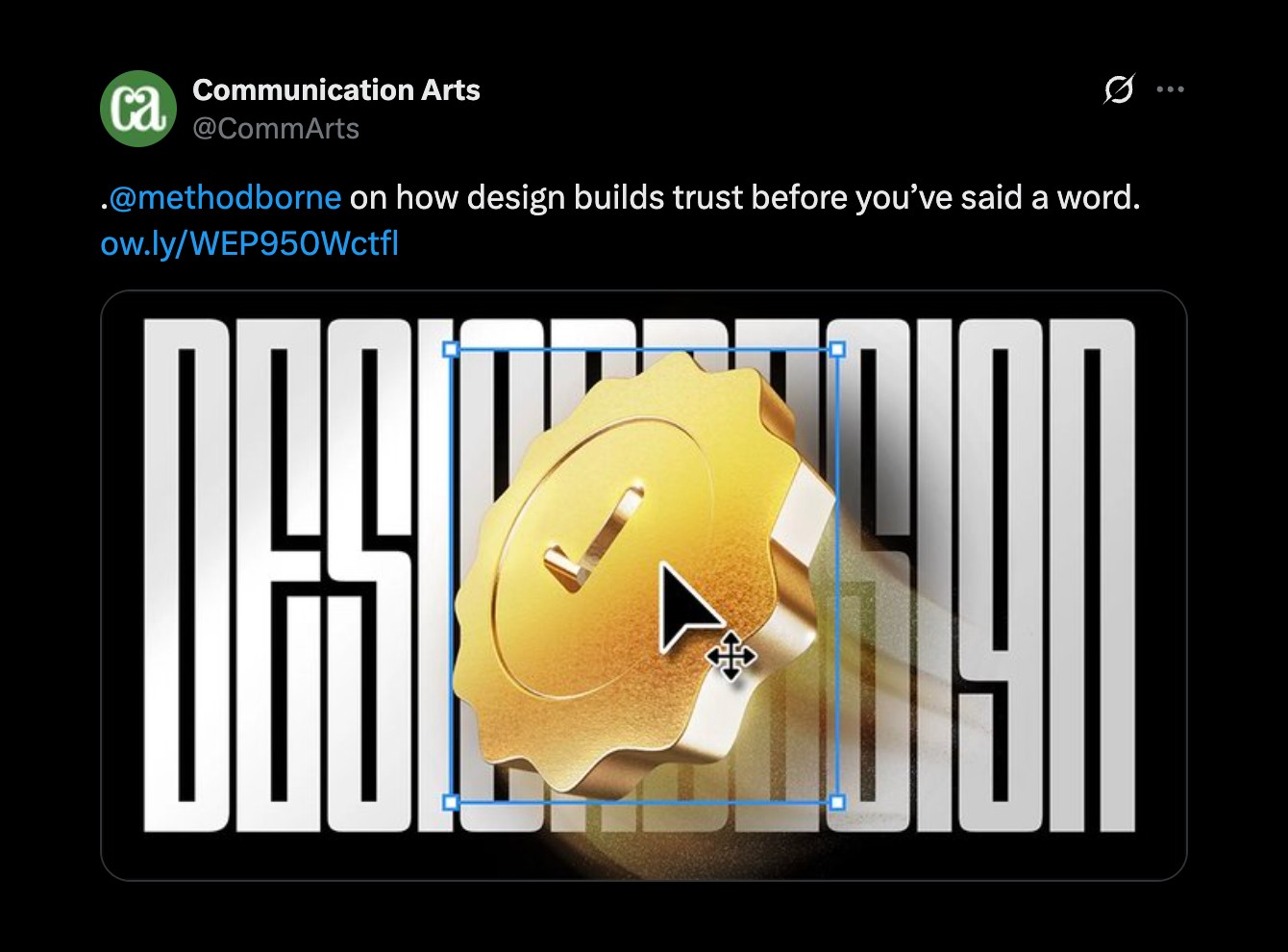
We’re saying this plainly because the way it happened matters more than the fact that it happened. Most “press” in our industry is bought, traded, or borrowed. This wasn’t.
Why Communication Arts matters
If you’ve spent any meaningful time in design, you already know. If you haven’t, here’s the short version.
Founded in August 1959 by Richard Coyne and Robert Blanchard in Palo Alto, Communication Arts is the largest international trade journal of visual communication. It was the first magazine in the United States printed entirely by offset lithography—a small detail that says everything about the publication’s instinct: care about the substrate, not just the surface. Sixty-six years on, it’s still family-run by the Coynes, still publishing six issues a year, and still hosting annual juried competitions in graphic design, advertising, photography, illustration, typography, and interactive media that are considered among the most respected awards in the field.
When CMOs and creative directors talk about whose opinion they trust on craft, CommArts is on the short list. It has been for three generations.
That’s the publication that featured our piece.
What they noticed
The argument we made in Design Builds Trust was deliberately uncomfortable: that trust isn’t earned after understanding—it’s decided at first sight, often within fifty milliseconds, before a single word of your value proposition has registered.
We backed it with the research. Tuch et al. and Lindgaard et al. on the fifty-millisecond first impression. MIT’s research on thirteen-millisecond image processing. Stanford’s Web Credibility Research on the visual basis of credibility judgments. Harvard Business Review on the neuroscience of trust. McKinsey’s Business Value of Design on the 32% revenue premium that design-led companies command over their peers.
But evidence wasn’t really the point. The point was naming what most founders, marketers, and even designers will not say out loud: that the entire industrial obsession with “shipping fast” has become a permission slip for shipping badly. That a $39 template, swapped a few words, dressed up with a logo, is not a brand—it’s a confession. That the people who claim design is decorative are, almost without exception, the ones whose products no one chooses twice.
CommArts featured the piece because it took a position. We don’t think they would have noticed had we hedged it.
The deeper argument, sharpened
Ten months on, we’d push the argument further than the original piece did.
The fifty-millisecond research is well-known in design circles. What’s less discussed is the asymmetry it implies. A first impression takes fifty milliseconds to form. According to subsequent work on impression updating (see Willis & Todorov, Princeton, on the speed and persistence of first judgments), it can take months of contradicting evidence to fully reverse. In some cases it never reverses.
Translate that to business. A founder who treats design as the last line item on a launch budget is not making a cost-saving decision. They are making a reversibility decision they don’t realise they’re making. They are betting that fifty milliseconds of bad signal can be undone by their product, their pricing, their pitch, their support—by everything downstream of the first glance. The research says it usually can’t. The accounting says it definitely shouldn’t have to.
This is the part of the trust thesis that reframes the cost question. The right question is not “what does great design cost?” The right question is: “what is one bad first impression, multiplied by every prospect you’ll ever lose to it, worth to me?” Almost no one calculates that number. Almost everyone underestimates it by an order of magnitude.
The companies that get this right—the Stripes, the Headspaces, the Airbnbs whose 2014 design overhaul tracked with a valuation jump from $10 billion to $31 billion in three years—are not running design as a cost line. They are running it as a compounding asset. Every interaction is a deposit into a trust account that pays out, year over year, in the form of customers who chose them over a competitor whose product was technically equivalent but whose first fifty milliseconds said something less believable.
That is the argument the original piece made. It’s the argument Communication Arts amplified. And it is, quietly, the argument that underwrites everything Methodborne does.
What this recognition means for us
We’re not going to be precious about it. A social feature from CommArts is not a Pulitzer. It is, however, the kind of unprompted external recognition that’s almost impossible to manufacture—and almost impossible to ignore when it happens. It told us two things, and we want to name both.
The first is about the work. If a publication that has spent six decades curating the best of visual communication chose to amplify a piece we wrote, the bet we’ve made on long-form, evidence-led, position-taking content is a bet worth continuing. There is an audience—and an editorial class—that still rewards conviction over cleverness. We intend to keep writing for them.
The second is about the studio. Methodborne is built on the premise that brand strategy, design, video, and engineering are not separate problems to be solved by separate vendors—they are facets of the same problem, and they get sharper when one team holds all four. The CommArts feature is, in a small way, evidence that the thinking we bring to client work is the same thinking we bring to our own publishing. The two are not separable. They never were.
What’s next
If you read the original piece and want to talk about how trust-building design might reshape how your customers see you in the next fifty milliseconds, we’d be glad to have that conversation.
If you’d rather just keep reading, we’d suggest Taste is Judgement: Why AI Can’t Replace Earned Discernment—the piece we published the week after the CommArts feature, which extends the argument in a direction we hadn’t expected to go.
Either way: thank you to Patrick Coyne and the Communication Arts team for the signal. We don’t take it lightly.
SHARE THIS
Related Articles

Creative Industry
Culture & Tech
Future of Work
The Great Blanding
1 May 2026
Creative Industry
Culture & Tech
Future of Work
Human Craft Is Worth More Than Ever: What Survives the Blanding
1 May 2026
Creative Industry
Culture & Tech
Future of Work
The Grift Class and the Economy of Anxiety
28 Apr 2026
Design
Feature
Press
Methodborne, Featured by Communication Arts
On 20 June 2025, Communication Arts—the international journal that has set the standard for visual communication since 1959—featured our piece on design and trust. They didn’t ask us for it. We didn’t pitch them. They simply noticed.
What happened
On 20 June 2025, Communication Arts featured our article How Design Builds Trust Before You’ve Said a Word on their official channels. No pitch. No outreach. No PR machinery. They read the piece, decided it was worth their readers’ time, and shared it with a global audience of designers, art directors, and creative leaders.
You can view the original feature here.
We’re saying this plainly because the way it happened matters more than the fact that it happened. Most “press” in our industry is bought, traded, or borrowed. This wasn’t.
Why Communication Arts matters
If you’ve spent any meaningful time in design, you already know. If you haven’t, here’s the short version.
Founded in August 1959 by Richard Coyne and Robert Blanchard in Palo Alto, Communication Arts is the largest international trade journal of visual communication. It was the first magazine in the United States printed entirely by offset lithography—a small detail that says everything about the publication’s instinct: care about the substrate, not just the surface. Sixty-six years on, it’s still family-run by the Coynes, still publishing six issues a year, and still hosting annual juried competitions in graphic design, advertising, photography, illustration, typography, and interactive media that are considered among the most respected awards in the field.
When CMOs and creative directors talk about whose opinion they trust on craft, CommArts is on the short list. It has been for three generations.
That’s the publication that featured our piece.
What they noticed
The argument we made in Design Builds Trust was deliberately uncomfortable: that trust isn’t earned after understanding—it’s decided at first sight, often within fifty milliseconds, before a single word of your value proposition has registered.
We backed it with the research. Tuch et al. and Lindgaard et al. on the fifty-millisecond first impression. MIT’s research on thirteen-millisecond image processing. Stanford’s Web Credibility Research on the visual basis of credibility judgments. Harvard Business Review on the neuroscience of trust. McKinsey’s Business Value of Design on the 32% revenue premium that design-led companies command over their peers.
But evidence wasn’t really the point. The point was naming what most founders, marketers, and even designers will not say out loud: that the entire industrial obsession with “shipping fast” has become a permission slip for shipping badly. That a $39 template, swapped a few words, dressed up with a logo, is not a brand—it’s a confession. That the people who claim design is decorative are, almost without exception, the ones whose products no one chooses twice.
CommArts featured the piece because it took a position. We don’t think they would have noticed had we hedged it.
The deeper argument, sharpened
Ten months on, we’d push the argument further than the original piece did.
The fifty-millisecond research is well-known in design circles. What’s less discussed is the asymmetry it implies. A first impression takes fifty milliseconds to form. According to subsequent work on impression updating (see Willis & Todorov, Princeton, on the speed and persistence of first judgments), it can take months of contradicting evidence to fully reverse. In some cases it never reverses.
Translate that to business. A founder who treats design as the last line item on a launch budget is not making a cost-saving decision. They are making a reversibility decision they don’t realise they’re making. They are betting that fifty milliseconds of bad signal can be undone by their product, their pricing, their pitch, their support—by everything downstream of the first glance. The research says it usually can’t. The accounting says it definitely shouldn’t have to.
This is the part of the trust thesis that reframes the cost question. The right question is not “what does great design cost?” The right question is: “what is one bad first impression, multiplied by every prospect you’ll ever lose to it, worth to me?” Almost no one calculates that number. Almost everyone underestimates it by an order of magnitude.
The companies that get this right—the Stripes, the Headspaces, the Airbnbs whose 2014 design overhaul tracked with a valuation jump from $10 billion to $31 billion in three years—are not running design as a cost line. They are running it as a compounding asset. Every interaction is a deposit into a trust account that pays out, year over year, in the form of customers who chose them over a competitor whose product was technically equivalent but whose first fifty milliseconds said something less believable.
That is the argument the original piece made. It’s the argument Communication Arts amplified. And it is, quietly, the argument that underwrites everything Methodborne does.
What this recognition means for us
We’re not going to be precious about it. A social feature from CommArts is not a Pulitzer. It is, however, the kind of unprompted external recognition that’s almost impossible to manufacture—and almost impossible to ignore when it happens. It told us two things, and we want to name both.
The first is about the work. If a publication that has spent six decades curating the best of visual communication chose to amplify a piece we wrote, the bet we’ve made on long-form, evidence-led, position-taking content is a bet worth continuing. There is an audience—and an editorial class—that still rewards conviction over cleverness. We intend to keep writing for them.
The second is about the studio. Methodborne is built on the premise that brand strategy, design, video, and engineering are not separate problems to be solved by separate vendors—they are facets of the same problem, and they get sharper when one team holds all four. The CommArts feature is, in a small way, evidence that the thinking we bring to client work is the same thinking we bring to our own publishing. The two are not separable. They never were.
What’s next
If you read the original piece and want to talk about how trust-building design might reshape how your customers see you in the next fifty milliseconds, we’d be glad to have that conversation.
If you’d rather just keep reading, we’d suggest Taste is Judgement: Why AI Can’t Replace Earned Discernment—the piece we published the week after the CommArts feature, which extends the argument in a direction we hadn’t expected to go.
Either way: thank you to Patrick Coyne and the Communication Arts team for the signal. We don’t take it lightly.
SHARE THIS
Related Articles
Creative Industry
Culture & Tech
Future of Work
The Great Blanding
1 May 2026
Creative Industry
Culture & Tech
Future of Work
Human Craft Is Worth More Than Ever: What Survives the Blanding
1 May 2026
Creative Industry
Culture & Tech
Future of Work
The Grift Class and the Economy of Anxiety
28 Apr 2026
Design
Feature
Press
Methodborne, Featured by Communication Arts
On 20 June 2025, Communication Arts—the international journal that has set the standard for visual communication since 1959—featured our piece on design and trust. They didn’t ask us for it. We didn’t pitch them. They simply noticed.
What happened
On 20 June 2025, Communication Arts featured our article How Design Builds Trust Before You’ve Said a Word on their official channels. No pitch. No outreach. No PR machinery. They read the piece, decided it was worth their readers’ time, and shared it with a global audience of designers, art directors, and creative leaders.
You can view the original feature here.
We’re saying this plainly because the way it happened matters more than the fact that it happened. Most “press” in our industry is bought, traded, or borrowed. This wasn’t.
Why Communication Arts matters
If you’ve spent any meaningful time in design, you already know. If you haven’t, here’s the short version.
Founded in August 1959 by Richard Coyne and Robert Blanchard in Palo Alto, Communication Arts is the largest international trade journal of visual communication. It was the first magazine in the United States printed entirely by offset lithography—a small detail that says everything about the publication’s instinct: care about the substrate, not just the surface. Sixty-six years on, it’s still family-run by the Coynes, still publishing six issues a year, and still hosting annual juried competitions in graphic design, advertising, photography, illustration, typography, and interactive media that are considered among the most respected awards in the field.
When CMOs and creative directors talk about whose opinion they trust on craft, CommArts is on the short list. It has been for three generations.
That’s the publication that featured our piece.
What they noticed
The argument we made in Design Builds Trust was deliberately uncomfortable: that trust isn’t earned after understanding—it’s decided at first sight, often within fifty milliseconds, before a single word of your value proposition has registered.
We backed it with the research. Tuch et al. and Lindgaard et al. on the fifty-millisecond first impression. MIT’s research on thirteen-millisecond image processing. Stanford’s Web Credibility Research on the visual basis of credibility judgments. Harvard Business Review on the neuroscience of trust. McKinsey’s Business Value of Design on the 32% revenue premium that design-led companies command over their peers.
But evidence wasn’t really the point. The point was naming what most founders, marketers, and even designers will not say out loud: that the entire industrial obsession with “shipping fast” has become a permission slip for shipping badly. That a $39 template, swapped a few words, dressed up with a logo, is not a brand—it’s a confession. That the people who claim design is decorative are, almost without exception, the ones whose products no one chooses twice.
CommArts featured the piece because it took a position. We don’t think they would have noticed had we hedged it.
The deeper argument, sharpened
Ten months on, we’d push the argument further than the original piece did.
The fifty-millisecond research is well-known in design circles. What’s less discussed is the asymmetry it implies. A first impression takes fifty milliseconds to form. According to subsequent work on impression updating (see Willis & Todorov, Princeton, on the speed and persistence of first judgments), it can take months of contradicting evidence to fully reverse. In some cases it never reverses.
Translate that to business. A founder who treats design as the last line item on a launch budget is not making a cost-saving decision. They are making a reversibility decision they don’t realise they’re making. They are betting that fifty milliseconds of bad signal can be undone by their product, their pricing, their pitch, their support—by everything downstream of the first glance. The research says it usually can’t. The accounting says it definitely shouldn’t have to.
This is the part of the trust thesis that reframes the cost question. The right question is not “what does great design cost?” The right question is: “what is one bad first impression, multiplied by every prospect you’ll ever lose to it, worth to me?” Almost no one calculates that number. Almost everyone underestimates it by an order of magnitude.
The companies that get this right—the Stripes, the Headspaces, the Airbnbs whose 2014 design overhaul tracked with a valuation jump from $10 billion to $31 billion in three years—are not running design as a cost line. They are running it as a compounding asset. Every interaction is a deposit into a trust account that pays out, year over year, in the form of customers who chose them over a competitor whose product was technically equivalent but whose first fifty milliseconds said something less believable.
That is the argument the original piece made. It’s the argument Communication Arts amplified. And it is, quietly, the argument that underwrites everything Methodborne does.
What this recognition means for us
We’re not going to be precious about it. A social feature from CommArts is not a Pulitzer. It is, however, the kind of unprompted external recognition that’s almost impossible to manufacture—and almost impossible to ignore when it happens. It told us two things, and we want to name both.
The first is about the work. If a publication that has spent six decades curating the best of visual communication chose to amplify a piece we wrote, the bet we’ve made on long-form, evidence-led, position-taking content is a bet worth continuing. There is an audience—and an editorial class—that still rewards conviction over cleverness. We intend to keep writing for them.
The second is about the studio. Methodborne is built on the premise that brand strategy, design, video, and engineering are not separate problems to be solved by separate vendors—they are facets of the same problem, and they get sharper when one team holds all four. The CommArts feature is, in a small way, evidence that the thinking we bring to client work is the same thinking we bring to our own publishing. The two are not separable. They never were.
What’s next
If you read the original piece and want to talk about how trust-building design might reshape how your customers see you in the next fifty milliseconds, we’d be glad to have that conversation.
If you’d rather just keep reading, we’d suggest Taste is Judgement: Why AI Can’t Replace Earned Discernment—the piece we published the week after the CommArts feature, which extends the argument in a direction we hadn’t expected to go.
Either way: thank you to Patrick Coyne and the Communication Arts team for the signal. We don’t take it lightly.
Design
Feature
Press
Methodborne, Featured by Communication Arts
On 20 June 2025, Communication Arts—the international journal that has set the standard for visual communication since 1959—featured our piece on design and trust. They didn’t ask us for it. We didn’t pitch them. They simply noticed.
What happened
On 20 June 2025, Communication Arts featured our article How Design Builds Trust Before You’ve Said a Word on their official channels. No pitch. No outreach. No PR machinery. They read the piece, decided it was worth their readers’ time, and shared it with a global audience of designers, art directors, and creative leaders.
You can view the original feature here.
We’re saying this plainly because the way it happened matters more than the fact that it happened. Most “press” in our industry is bought, traded, or borrowed. This wasn’t.
Why Communication Arts matters
If you’ve spent any meaningful time in design, you already know. If you haven’t, here’s the short version.
Founded in August 1959 by Richard Coyne and Robert Blanchard in Palo Alto, Communication Arts is the largest international trade journal of visual communication. It was the first magazine in the United States printed entirely by offset lithography—a small detail that says everything about the publication’s instinct: care about the substrate, not just the surface. Sixty-six years on, it’s still family-run by the Coynes, still publishing six issues a year, and still hosting annual juried competitions in graphic design, advertising, photography, illustration, typography, and interactive media that are considered among the most respected awards in the field.
When CMOs and creative directors talk about whose opinion they trust on craft, CommArts is on the short list. It has been for three generations.
That’s the publication that featured our piece.
What they noticed
The argument we made in Design Builds Trust was deliberately uncomfortable: that trust isn’t earned after understanding—it’s decided at first sight, often within fifty milliseconds, before a single word of your value proposition has registered.
We backed it with the research. Tuch et al. and Lindgaard et al. on the fifty-millisecond first impression. MIT’s research on thirteen-millisecond image processing. Stanford’s Web Credibility Research on the visual basis of credibility judgments. Harvard Business Review on the neuroscience of trust. McKinsey’s Business Value of Design on the 32% revenue premium that design-led companies command over their peers.
But evidence wasn’t really the point. The point was naming what most founders, marketers, and even designers will not say out loud: that the entire industrial obsession with “shipping fast” has become a permission slip for shipping badly. That a $39 template, swapped a few words, dressed up with a logo, is not a brand—it’s a confession. That the people who claim design is decorative are, almost without exception, the ones whose products no one chooses twice.
CommArts featured the piece because it took a position. We don’t think they would have noticed had we hedged it.
The deeper argument, sharpened
Ten months on, we’d push the argument further than the original piece did.
The fifty-millisecond research is well-known in design circles. What’s less discussed is the asymmetry it implies. A first impression takes fifty milliseconds to form. According to subsequent work on impression updating (see Willis & Todorov, Princeton, on the speed and persistence of first judgments), it can take months of contradicting evidence to fully reverse. In some cases it never reverses.
Translate that to business. A founder who treats design as the last line item on a launch budget is not making a cost-saving decision. They are making a reversibility decision they don’t realise they’re making. They are betting that fifty milliseconds of bad signal can be undone by their product, their pricing, their pitch, their support—by everything downstream of the first glance. The research says it usually can’t. The accounting says it definitely shouldn’t have to.
This is the part of the trust thesis that reframes the cost question. The right question is not “what does great design cost?” The right question is: “what is one bad first impression, multiplied by every prospect you’ll ever lose to it, worth to me?” Almost no one calculates that number. Almost everyone underestimates it by an order of magnitude.
The companies that get this right—the Stripes, the Headspaces, the Airbnbs whose 2014 design overhaul tracked with a valuation jump from $10 billion to $31 billion in three years—are not running design as a cost line. They are running it as a compounding asset. Every interaction is a deposit into a trust account that pays out, year over year, in the form of customers who chose them over a competitor whose product was technically equivalent but whose first fifty milliseconds said something less believable.
That is the argument the original piece made. It’s the argument Communication Arts amplified. And it is, quietly, the argument that underwrites everything Methodborne does.
What this recognition means for us
We’re not going to be precious about it. A social feature from CommArts is not a Pulitzer. It is, however, the kind of unprompted external recognition that’s almost impossible to manufacture—and almost impossible to ignore when it happens. It told us two things, and we want to name both.
The first is about the work. If a publication that has spent six decades curating the best of visual communication chose to amplify a piece we wrote, the bet we’ve made on long-form, evidence-led, position-taking content is a bet worth continuing. There is an audience—and an editorial class—that still rewards conviction over cleverness. We intend to keep writing for them.
The second is about the studio. Methodborne is built on the premise that brand strategy, design, video, and engineering are not separate problems to be solved by separate vendors—they are facets of the same problem, and they get sharper when one team holds all four. The CommArts feature is, in a small way, evidence that the thinking we bring to client work is the same thinking we bring to our own publishing. The two are not separable. They never were.
What’s next
If you read the original piece and want to talk about how trust-building design might reshape how your customers see you in the next fifty milliseconds, we’d be glad to have that conversation.
If you’d rather just keep reading, we’d suggest Taste is Judgement: Why AI Can’t Replace Earned Discernment—the piece we published the week after the CommArts feature, which extends the argument in a direction we hadn’t expected to go.
Either way: thank you to Patrick Coyne and the Communication Arts team for the signal. We don’t take it lightly.
Design
Feature
Press
Methodborne, Featured by Communication Arts
On 20 June 2025, Communication Arts—the international journal that has set the standard for visual communication since 1959—featured our piece on design and trust. They didn’t ask us for it. We didn’t pitch them. They simply noticed.
What happened
On 20 June 2025, Communication Arts featured our article How Design Builds Trust Before You’ve Said a Word on their official channels. No pitch. No outreach. No PR machinery. They read the piece, decided it was worth their readers’ time, and shared it with a global audience of designers, art directors, and creative leaders.
You can view the original feature here.
We’re saying this plainly because the way it happened matters more than the fact that it happened. Most “press” in our industry is bought, traded, or borrowed. This wasn’t.
Why Communication Arts matters
If you’ve spent any meaningful time in design, you already know. If you haven’t, here’s the short version.
Founded in August 1959 by Richard Coyne and Robert Blanchard in Palo Alto, Communication Arts is the largest international trade journal of visual communication. It was the first magazine in the United States printed entirely by offset lithography—a small detail that says everything about the publication’s instinct: care about the substrate, not just the surface. Sixty-six years on, it’s still family-run by the Coynes, still publishing six issues a year, and still hosting annual juried competitions in graphic design, advertising, photography, illustration, typography, and interactive media that are considered among the most respected awards in the field.
When CMOs and creative directors talk about whose opinion they trust on craft, CommArts is on the short list. It has been for three generations.
That’s the publication that featured our piece.
What they noticed
The argument we made in Design Builds Trust was deliberately uncomfortable: that trust isn’t earned after understanding—it’s decided at first sight, often within fifty milliseconds, before a single word of your value proposition has registered.
We backed it with the research. Tuch et al. and Lindgaard et al. on the fifty-millisecond first impression. MIT’s research on thirteen-millisecond image processing. Stanford’s Web Credibility Research on the visual basis of credibility judgments. Harvard Business Review on the neuroscience of trust. McKinsey’s Business Value of Design on the 32% revenue premium that design-led companies command over their peers.
But evidence wasn’t really the point. The point was naming what most founders, marketers, and even designers will not say out loud: that the entire industrial obsession with “shipping fast” has become a permission slip for shipping badly. That a $39 template, swapped a few words, dressed up with a logo, is not a brand—it’s a confession. That the people who claim design is decorative are, almost without exception, the ones whose products no one chooses twice.
CommArts featured the piece because it took a position. We don’t think they would have noticed had we hedged it.
The deeper argument, sharpened
Ten months on, we’d push the argument further than the original piece did.
The fifty-millisecond research is well-known in design circles. What’s less discussed is the asymmetry it implies. A first impression takes fifty milliseconds to form. According to subsequent work on impression updating (see Willis & Todorov, Princeton, on the speed and persistence of first judgments), it can take months of contradicting evidence to fully reverse. In some cases it never reverses.
Translate that to business. A founder who treats design as the last line item on a launch budget is not making a cost-saving decision. They are making a reversibility decision they don’t realise they’re making. They are betting that fifty milliseconds of bad signal can be undone by their product, their pricing, their pitch, their support—by everything downstream of the first glance. The research says it usually can’t. The accounting says it definitely shouldn’t have to.
This is the part of the trust thesis that reframes the cost question. The right question is not “what does great design cost?” The right question is: “what is one bad first impression, multiplied by every prospect you’ll ever lose to it, worth to me?” Almost no one calculates that number. Almost everyone underestimates it by an order of magnitude.
The companies that get this right—the Stripes, the Headspaces, the Airbnbs whose 2014 design overhaul tracked with a valuation jump from $10 billion to $31 billion in three years—are not running design as a cost line. They are running it as a compounding asset. Every interaction is a deposit into a trust account that pays out, year over year, in the form of customers who chose them over a competitor whose product was technically equivalent but whose first fifty milliseconds said something less believable.
That is the argument the original piece made. It’s the argument Communication Arts amplified. And it is, quietly, the argument that underwrites everything Methodborne does.
What this recognition means for us
We’re not going to be precious about it. A social feature from CommArts is not a Pulitzer. It is, however, the kind of unprompted external recognition that’s almost impossible to manufacture—and almost impossible to ignore when it happens. It told us two things, and we want to name both.
The first is about the work. If a publication that has spent six decades curating the best of visual communication chose to amplify a piece we wrote, the bet we’ve made on long-form, evidence-led, position-taking content is a bet worth continuing. There is an audience—and an editorial class—that still rewards conviction over cleverness. We intend to keep writing for them.
The second is about the studio. Methodborne is built on the premise that brand strategy, design, video, and engineering are not separate problems to be solved by separate vendors—they are facets of the same problem, and they get sharper when one team holds all four. The CommArts feature is, in a small way, evidence that the thinking we bring to client work is the same thinking we bring to our own publishing. The two are not separable. They never were.
What’s next
If you read the original piece and want to talk about how trust-building design might reshape how your customers see you in the next fifty milliseconds, we’d be glad to have that conversation.
If you’d rather just keep reading, we’d suggest Taste is Judgement: Why AI Can’t Replace Earned Discernment—the piece we published the week after the CommArts feature, which extends the argument in a direction we hadn’t expected to go.
Either way: thank you to Patrick Coyne and the Communication Arts team for the signal. We don’t take it lightly.
SHARE THIS
Related Articles
Creative Industry
Culture & Tech
Future of Work
The Great Blanding
1 May 2026
Creative Industry
Culture & Tech
Future of Work
Human Craft Is Worth More Than Ever: What Survives the Blanding
1 May 2026
Creative Industry
Culture & Tech
Future of Work
The Grift Class and the Economy of Anxiety
28 Apr 2026
Design
Feature
Press
Methodborne, Featured by Communication Arts
On 20 June 2025, Communication Arts—the international journal that has set the standard for visual communication since 1959—featured our piece on design and trust. They didn’t ask us for it. We didn’t pitch them. They simply noticed.
What happened
On 20 June 2025, Communication Arts featured our article How Design Builds Trust Before You’ve Said a Word on their official channels. No pitch. No outreach. No PR machinery. They read the piece, decided it was worth their readers’ time, and shared it with a global audience of designers, art directors, and creative leaders.
You can view the original feature here.
We’re saying this plainly because the way it happened matters more than the fact that it happened. Most “press” in our industry is bought, traded, or borrowed. This wasn’t.
Why Communication Arts matters
If you’ve spent any meaningful time in design, you already know. If you haven’t, here’s the short version.
Founded in August 1959 by Richard Coyne and Robert Blanchard in Palo Alto, Communication Arts is the largest international trade journal of visual communication. It was the first magazine in the United States printed entirely by offset lithography—a small detail that says everything about the publication’s instinct: care about the substrate, not just the surface. Sixty-six years on, it’s still family-run by the Coynes, still publishing six issues a year, and still hosting annual juried competitions in graphic design, advertising, photography, illustration, typography, and interactive media that are considered among the most respected awards in the field.
When CMOs and creative directors talk about whose opinion they trust on craft, CommArts is on the short list. It has been for three generations.
That’s the publication that featured our piece.
What they noticed
The argument we made in Design Builds Trust was deliberately uncomfortable: that trust isn’t earned after understanding—it’s decided at first sight, often within fifty milliseconds, before a single word of your value proposition has registered.
We backed it with the research. Tuch et al. and Lindgaard et al. on the fifty-millisecond first impression. MIT’s research on thirteen-millisecond image processing. Stanford’s Web Credibility Research on the visual basis of credibility judgments. Harvard Business Review on the neuroscience of trust. McKinsey’s Business Value of Design on the 32% revenue premium that design-led companies command over their peers.
But evidence wasn’t really the point. The point was naming what most founders, marketers, and even designers will not say out loud: that the entire industrial obsession with “shipping fast” has become a permission slip for shipping badly. That a $39 template, swapped a few words, dressed up with a logo, is not a brand—it’s a confession. That the people who claim design is decorative are, almost without exception, the ones whose products no one chooses twice.
CommArts featured the piece because it took a position. We don’t think they would have noticed had we hedged it.
The deeper argument, sharpened
Ten months on, we’d push the argument further than the original piece did.
The fifty-millisecond research is well-known in design circles. What’s less discussed is the asymmetry it implies. A first impression takes fifty milliseconds to form. According to subsequent work on impression updating (see Willis & Todorov, Princeton, on the speed and persistence of first judgments), it can take months of contradicting evidence to fully reverse. In some cases it never reverses.
Translate that to business. A founder who treats design as the last line item on a launch budget is not making a cost-saving decision. They are making a reversibility decision they don’t realise they’re making. They are betting that fifty milliseconds of bad signal can be undone by their product, their pricing, their pitch, their support—by everything downstream of the first glance. The research says it usually can’t. The accounting says it definitely shouldn’t have to.
This is the part of the trust thesis that reframes the cost question. The right question is not “what does great design cost?” The right question is: “what is one bad first impression, multiplied by every prospect you’ll ever lose to it, worth to me?” Almost no one calculates that number. Almost everyone underestimates it by an order of magnitude.
The companies that get this right—the Stripes, the Headspaces, the Airbnbs whose 2014 design overhaul tracked with a valuation jump from $10 billion to $31 billion in three years—are not running design as a cost line. They are running it as a compounding asset. Every interaction is a deposit into a trust account that pays out, year over year, in the form of customers who chose them over a competitor whose product was technically equivalent but whose first fifty milliseconds said something less believable.
That is the argument the original piece made. It’s the argument Communication Arts amplified. And it is, quietly, the argument that underwrites everything Methodborne does.
What this recognition means for us
We’re not going to be precious about it. A social feature from CommArts is not a Pulitzer. It is, however, the kind of unprompted external recognition that’s almost impossible to manufacture—and almost impossible to ignore when it happens. It told us two things, and we want to name both.
The first is about the work. If a publication that has spent six decades curating the best of visual communication chose to amplify a piece we wrote, the bet we’ve made on long-form, evidence-led, position-taking content is a bet worth continuing. There is an audience—and an editorial class—that still rewards conviction over cleverness. We intend to keep writing for them.
The second is about the studio. Methodborne is built on the premise that brand strategy, design, video, and engineering are not separate problems to be solved by separate vendors—they are facets of the same problem, and they get sharper when one team holds all four. The CommArts feature is, in a small way, evidence that the thinking we bring to client work is the same thinking we bring to our own publishing. The two are not separable. They never were.
What’s next
If you read the original piece and want to talk about how trust-building design might reshape how your customers see you in the next fifty milliseconds, we’d be glad to have that conversation.
If you’d rather just keep reading, we’d suggest Taste is Judgement: Why AI Can’t Replace Earned Discernment—the piece we published the week after the CommArts feature, which extends the argument in a direction we hadn’t expected to go.
Either way: thank you to Patrick Coyne and the Communication Arts team for the signal. We don’t take it lightly.
SHARE THIS
Related Articles
Creative Industry
Culture & Tech
Future of Work
The Great Blanding
1 May 2026
Creative Industry
Culture & Tech
Future of Work
Human Craft Is Worth More Than Ever: What Survives the Blanding
1 May 2026
Creative Industry
Culture & Tech
Future of Work
The Grift Class and the Economy of Anxiety
28 Apr 2026
Design
Feature
Press
Methodborne, Featured by Communication Arts
On 20 June 2025, Communication Arts—the international journal that has set the standard for visual communication since 1959—featured our piece on design and trust. They didn’t ask us for it. We didn’t pitch them. They simply noticed.
What happened
On 20 June 2025, Communication Arts featured our article How Design Builds Trust Before You’ve Said a Word on their official channels. No pitch. No outreach. No PR machinery. They read the piece, decided it was worth their readers’ time, and shared it with a global audience of designers, art directors, and creative leaders.
You can view the original feature here.
We’re saying this plainly because the way it happened matters more than the fact that it happened. Most “press” in our industry is bought, traded, or borrowed. This wasn’t.
Why Communication Arts matters
If you’ve spent any meaningful time in design, you already know. If you haven’t, here’s the short version.
Founded in August 1959 by Richard Coyne and Robert Blanchard in Palo Alto, Communication Arts is the largest international trade journal of visual communication. It was the first magazine in the United States printed entirely by offset lithography—a small detail that says everything about the publication’s instinct: care about the substrate, not just the surface. Sixty-six years on, it’s still family-run by the Coynes, still publishing six issues a year, and still hosting annual juried competitions in graphic design, advertising, photography, illustration, typography, and interactive media that are considered among the most respected awards in the field.
When CMOs and creative directors talk about whose opinion they trust on craft, CommArts is on the short list. It has been for three generations.
That’s the publication that featured our piece.
What they noticed
The argument we made in Design Builds Trust was deliberately uncomfortable: that trust isn’t earned after understanding—it’s decided at first sight, often within fifty milliseconds, before a single word of your value proposition has registered.
We backed it with the research. Tuch et al. and Lindgaard et al. on the fifty-millisecond first impression. MIT’s research on thirteen-millisecond image processing. Stanford’s Web Credibility Research on the visual basis of credibility judgments. Harvard Business Review on the neuroscience of trust. McKinsey’s Business Value of Design on the 32% revenue premium that design-led companies command over their peers.
But evidence wasn’t really the point. The point was naming what most founders, marketers, and even designers will not say out loud: that the entire industrial obsession with “shipping fast” has become a permission slip for shipping badly. That a $39 template, swapped a few words, dressed up with a logo, is not a brand—it’s a confession. That the people who claim design is decorative are, almost without exception, the ones whose products no one chooses twice.
CommArts featured the piece because it took a position. We don’t think they would have noticed had we hedged it.
The deeper argument, sharpened
Ten months on, we’d push the argument further than the original piece did.
The fifty-millisecond research is well-known in design circles. What’s less discussed is the asymmetry it implies. A first impression takes fifty milliseconds to form. According to subsequent work on impression updating (see Willis & Todorov, Princeton, on the speed and persistence of first judgments), it can take months of contradicting evidence to fully reverse. In some cases it never reverses.
Translate that to business. A founder who treats design as the last line item on a launch budget is not making a cost-saving decision. They are making a reversibility decision they don’t realise they’re making. They are betting that fifty milliseconds of bad signal can be undone by their product, their pricing, their pitch, their support—by everything downstream of the first glance. The research says it usually can’t. The accounting says it definitely shouldn’t have to.
This is the part of the trust thesis that reframes the cost question. The right question is not “what does great design cost?” The right question is: “what is one bad first impression, multiplied by every prospect you’ll ever lose to it, worth to me?” Almost no one calculates that number. Almost everyone underestimates it by an order of magnitude.
The companies that get this right—the Stripes, the Headspaces, the Airbnbs whose 2014 design overhaul tracked with a valuation jump from $10 billion to $31 billion in three years—are not running design as a cost line. They are running it as a compounding asset. Every interaction is a deposit into a trust account that pays out, year over year, in the form of customers who chose them over a competitor whose product was technically equivalent but whose first fifty milliseconds said something less believable.
That is the argument the original piece made. It’s the argument Communication Arts amplified. And it is, quietly, the argument that underwrites everything Methodborne does.
What this recognition means for us
We’re not going to be precious about it. A social feature from CommArts is not a Pulitzer. It is, however, the kind of unprompted external recognition that’s almost impossible to manufacture—and almost impossible to ignore when it happens. It told us two things, and we want to name both.
The first is about the work. If a publication that has spent six decades curating the best of visual communication chose to amplify a piece we wrote, the bet we’ve made on long-form, evidence-led, position-taking content is a bet worth continuing. There is an audience—and an editorial class—that still rewards conviction over cleverness. We intend to keep writing for them.
The second is about the studio. Methodborne is built on the premise that brand strategy, design, video, and engineering are not separate problems to be solved by separate vendors—they are facets of the same problem, and they get sharper when one team holds all four. The CommArts feature is, in a small way, evidence that the thinking we bring to client work is the same thinking we bring to our own publishing. The two are not separable. They never were.
What’s next
If you read the original piece and want to talk about how trust-building design might reshape how your customers see you in the next fifty milliseconds, we’d be glad to have that conversation.
If you’d rather just keep reading, we’d suggest Taste is Judgement: Why AI Can’t Replace Earned Discernment—the piece we published the week after the CommArts feature, which extends the argument in a direction we hadn’t expected to go.
Either way: thank you to Patrick Coyne and the Communication Arts team for the signal. We don’t take it lightly.
/
Blog